

Best Friends Animal Sanctuary
Reception Building

Avian greeters

Joey, Hyacinth Macaw
South America

Honey, Major Mitchell Cocaktoo
Australia

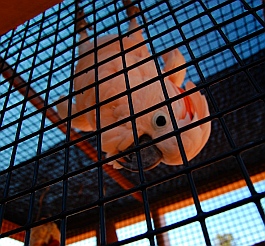
Seppi, Mollucan Cockatoo
native to Indonesia
Writes a column in the monthly magazine

Quetzl, Congo African Grey
Age 54 - the same as Mark!

Tika, Umbrella Cockatoo, native to Indonesia

"Angel Canyon"
The sanctuary sits on 5 stunning square miles

Rescued horses live in Horse Haven

Angel's Rest Cemetery

Cemetery plots for all the animals. No animals are
killed; most are fostered out to new homes; a lucky
few live out their days at the sanctuary.

The cat house

Siesta time


Bunny companionship

All the bunnies, dogs and cats
have indoor/outdoor living
quarters, and they come and go
at will.

Nothing like some soft green grass for your
campsite.


Martin Tyner & Thumper, a Harris Hawk
22 years old, reaches speeds of 100 mph

Igor, a Prairie Falcon
Dives for prey at 200 mph

Scout, a Golden Eagle
Can spot a yummy rabbit from 5 miles away.

Golden Eagle: 7 lbs and 7,000 feathers
Can reach altitudes of 35,000 feet
and hurtle towards earth at 145 mph

Each raptor got many hugs during the seminar.
A different golden eagle was released later that day
from an overlook in Cedar City, UT.
Utah Sanctuaries: Best Friends & Southwest Wildlife Foundation
July 15-19, 2008 - Kanab, Utah sits squarely between three of
the greatest national parks in the US, and we stopped there,
along with everyone else, for supplies, water and haircuts. We
didn't intend to stay, but as we were leaving town we saw a cute
sign that said "Best Friends Animal Sanctuary" with an arrow
pointing down a winding road that seemed to go deep into a
canyon. We couldn't resist the temptation and took that turn.
Four days later we finally emerged!!
Best Friends is a unique,
extraordinarily well-funded and
beautiful no-kill animal shelter.
It sits on 5 square miles of
exotic red rock canyon and
houses 2,000 animals. Their
mission is to find homes for all
the animals that are adoptable, while the rest are allowed to live out their days in the loving care
of an enormous staff. The grounds and landscaping alone are worth seeing, but it was the
many tours of the various animal areas that kept us in that canyon so long.
I am a bird lover, and the parrot garden is a treat. On
summer days, all the parrots are kept in outdoor enclosures under a canopy of huge shade
trees near a pretty waterfall feature. Visitors are invited to interact with the parrots, and we
spent many happy hours entertaining and being entertained by these squawking, talking,
feathered comedians. The parrots' nighttime quarters
are indoors, so twice a day during the summer months
the bird caretakers do the Parrot Parade, carrying each
bird between its indoor enclosure and its outdoor
enclosure. On the hottest summer afternoons the
caretakers walk around misting the birds with water
sprayers to help them stay cool. What a life!
An important
theme at the
sanctuary is
positive
interactions
between the
animals and
people. All the tours are free, and you can
volunteer to stick around and work with your
favorite animals for as little as a few hours or
for as long as you want to stay. There are
cabins and a tiny RV park in the canyon to
accommodate volunteers, and many return
for a week or two every year.
Seppi, a Mollucan cockatoo, likes to walk
along the underside of the
roof of his cage, hanging
upside down and talking to
you. Quetzl, a quiet
African Grey, was hatched
in 1954 but doesn't look a
day over five. Tika, an
Umbrella cockatoo, was
summering at the sanctuary
while his owner took care of
some personal challenges.
He was accustomed to a lot
of attention, so he was happy
to climb into my arms and get
some free cuddles for a while.
The canyon, officially "Kanab Canyon" but affectionately called "Angel Canyon," is a
dramatic gorge lined with towering red rock cliffs. Most sanctuary tours require a
shuttlebus ride of a few miles from the reception building out into the rest of the
property: Dogtown Heights, the Cat House, Feathered Friends and the Bunny House.
The drive along the cliff's edges is stunning, and we passed some
of the sanctuary horses who live a charmed life, grazing in peace
while gazing at multi-million dollar views.
Angel's Rest cemetery is along this road as well. Every animal that dies at the
shelter is buried here with a headstone. There are tiny plots for the little birds and
big plots for the large farm animals. Even horses, goats and cows are adopted out
to new homes, whenever possible, and the video shown hourly at the reception
building included snapshots of many happy people who had become loving owners
of goats, sheep and other farm animals.
Most of the animal
buildings are built with
wings that provide an
indoor shelter with a
doorway the animals can
pass through to reach an
outdoor shelter. At the
cat house, the outdoor areas include ladders, pillowed perches, and a
lattice-work of planks and shelving near the ceiling. Litter boxes, food
and water dishes are discreetly placed in these out-of-reach alcoves.
Looking up, all we could see was the
odd paw or tail hanging down from
the lofty hideaways. It was siesta
time, and all the cats were happily
dozing.
The bunnies have indoor/outdoor
housing as well, and since bunnies
like to cuddle, many had a stuffed
bunny to snuggle up to. Outside, one bunny
was working very hard digging a hole, while a
few others were taking a load off under little
tent-like canopies that offered cool shade in a
lush bed of soft green grass.
Dogtown was a busy barking array of buildings. Most of the
dogs from Michael Vicks' dog-fighting operation had just been
rescued, and many dogs from Katrina were still in transition
here. We heard amazing stories of animal rescues. One lady
had 200 guinea pigs living in her 10' x 10' kitchen, and another
wacko had 1,600 rabbits in her back yard. 1,000 cats were
taken from a crazy lady's home in Pahrump, Nevada, and as I
heard the tale from a caretaker I remembered reading about it in
the Pahrump newspaper when we visited eight months earlier.
All those cats, rabbits and guinea pigs had passed through Best
Friends to new owners or were still at the sanctuary hoping for
new homes.
Before an animal is adopted out, it must go on an overnight stay to ensure that it is a well-behaved
propsective pet. Visitors can volunteer for these overnight stays, without obligation, at Parry Lodge in
Kanab. If the animal flunks the test, it simply gets a little more loving at the sanctuary, as the caretakers
work to improve its manners.
August 30, 2008 - In Parowan, Utah, at the Iron
County State Fair, we attended a fantastic
demonstration and talk by Martin Tyner, founder
of Southwest Wildlife Foundation. His
sanctuary focuses on rehabilitating native
creatures and returning them to the wild. It was
my understanding that Rocky Mountain Power
Company has recently donated a huge, multi-million dollar parcel of land
to this sanctuary. Eventually, once money is raised for land
improvements and building construction, this foundation could become
for native wildlife what Best Friends already is for more domesticated
animals.
He had three raptors with him: a Harris Hawk, a Prairie Falcon and a
Golden Eagle. He is a Master Falconer, and although he uses each of these
particular birds for education purposes, he takes them all out hunting on a
regular basis to keep their natural instincts sharp. His job is to flush out rabbits
and other prey from the desert brush so the raptors can catch their meals. They
fly free, and they fly high, happy to have a trained human to take the guesswork
out of finding dinner.
He told us of the highly aggressive nature of the Prairie Falcon, a slim bird that
screamed periodically throughout his talk. A few years back he had rescued and
rehabilitated a particularly aggressive female that had deserved her nickname
"Horrible." He released her into the desert near Cedar City, and she became a
great mom and has raised several clutches of young since then. But she's oh-
so-smart. She recognizes his truck from their many hunting outings together
when she was in his care. Now, when he brings other raptors into the desert to
hunt, she goes out of her way to tease and harrass him. One time, as he stood
with his arm outstretched waiting for his raptor to return to him, she dived
at him from the other direction, knocking him to the ground six feet away!
At the moment of impact, he suddenly understood exactly the kind of
blood-draining terror that rabbits feel when a Prairie Falcon singles them
out for a lunch date.
He invited everyone at the talk to come out to the highest ridge in Cedar
City later that afternoon to witness his release of a Golden Eagle back
into the wild. We didn't attend, but he said that whenever he releases a
bird he welcomes spectators, so hopefully we will watch a release
another time. He told us that the local Paiute Indians have a special
relationship with Golden Eagles. They believe that if you say a prayer
over an eagle feather, the prayer will
be carried directly to God. The Golden
Eagle being released that afternoon
was going to carry prayers for more
than 4,000 local cancer victims, the "down winders" in southern Utah who contracted cancer as a
direct result of the Cold War era nuclear testing carried out next door in Nevada.
Unrelated to these two wonderful animal sanctuaries in Utah, I recently discovered that Bird
Lovers Only Rescue in Dyer, Indiana has a very funny movie clip of a lesser sulphur crested
cockatoo dancing to the beat of the Backstreet Boys here. It puts a smile on my face every time I
watch it.
We spent the summer of 2008 bee-bopping around souther Utah, and one of the most eye-
popping stops was at the majestic Bryce Canyon National Park.