


Macinaw Bridge

View from our motel room.

St. Ignace Lighthouse at dusk.


Welcome to Hessel
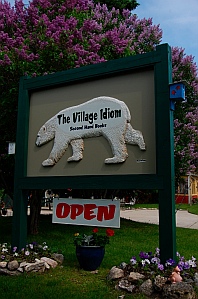
An urban bookstore in the
most remote setting.


100 year old lilac bush in all its glory.

Woodland jewels: lillies-of-the-valley.


Hessel is a quiet village.

Lazy afternoons watching the small bay over a beer.

A 1942 Chris Craft perfectly restored.


Great Lakes Boat Building School

All students build a flat-bottomed skiff.

Planks waiting to become boats.

Yet another coat of varnish dries...

A 32' footer is prepped for
shipment to Harbor Springs

Pasties -- meat-and-veggie pies I first
tasted in Australia

Snowmobiles are the best
vehicle come winter.

Sprawling farms grace the landscape.

Two sandhill cranes poke along
down a dirt road.

Lake Superior's forbidding shoreline.

Lake Superior Ice-water. How did those girls
manage to go in all the way?
Upper Peninsula - St. Ignace & Hessel
Mid-June, 2009 - We left the cute, warm, Northern Lake Michigan coastal towns and ventured over the Macinaw Bridge to the
rather forbidding Upper Peninsula. The bridge is a magnificent structure, and as we crossed it Mark told me a little about this other
side of Michigan. The "Yoopers," inhabitants of the UP, are a breed apart. They can withstand truly frigid winters and take great
pride in being from a vast land that shares little with the urban jungle of Detroit or the gentrified small towns of the warmer regions
to the south. There is a ruggedness here, an almost frontier quality, that increases dramatically the further you get from the
Macinaw Bridge.
We didn't get too far. The
small town of St. Ignace
beckoned to us just after we
crossed the bridge.
Bypassing the very elegant
waterfront Best Western that
advertised, "We aren't
expensive, we just look that
way," we stayed instead at a
small inn overlooking the
lighthouse. Several motels
were closed permanently, and
those that were open had few
patrons.
We were the only visitors at our motel for the night, and we had our pick
of any room we wanted. Given that opportunity, I wanted to make sure
our picture window framed the lighthouse just right. Mark and the inn
keeper shared some sidelong glances and rolled eyes as I vacillated
between two rooms, popping in and out of each one several times. "You
should see her pick out a table at a restaurant..." Mark sighed with a
smile.
Later on he agreed
it was worth it: as
the sun set and the
lighthouse slowly
winked at us
during the evening,
we both grabbed
our cameras.
St. Ignace has
a long wooden
boardwalk that
meanders along the edge of the harbor. We walked along it the next
morning and found a swan and its babies paddling in the water.
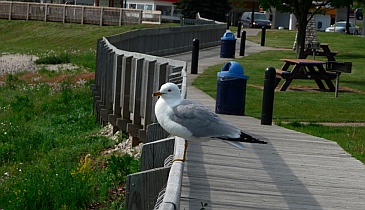
A seagull surveyed the scene and eyed me up for breadcrumbs. I
threw out a few and within seconds I was surrounded by the whole
flock and engaged in a wild game of catch. I would throw pieces of
bread as high in the air as I could, and the gulls would swoop by and
effortlessly catch the bread in mid-air in an amazing aerobatic
display.
Back in Traverse City, along the
northern part of Lake Michigan, we
had met Liz Fels who was staging an
exhibit of her photography. She was
from the tiny town of Hessel in the
UP, and she recommended that we
stop by her bookstore/gallery when
we got up that way. Hessel's
welcome sign made the town seem
like a happening place, but when we
got there we found a lovely, sleepy
little hamlet that boasts just a handful
of shops and an eatery or two.
It wasn't hard to find "The Village
Idiom," Liz's bookstore/gallery, and
what a find it was. For any
enthusiastic reader spending time in
the raw lands of the UP, this store,
brimming with used books, is a rare jewel.
Not only is there space to unwind your mind inside with shelves of
unusual titles and a gallery of pretty photographs, but there is space
outside to take your new read, relax, and check it out under the sun.
When I commented on how beautiful all the lilacs were around town, she
took me to her back yard where there is a 100 year old lilac tree. It was
immense and it was in full bloom.
I had a field day with flowers in this town. A few doors down from the
bookstore I found a huge patch of lilies-of-the-valley.
You don't spot these forest gems too often, and Mark and I
both laid down to get a whiff of their heady scent. A group of
cyclists going by stopped and gathered around us to see why
we were sprawled out on the sidewalk. Ah, they nodded to
each other knowingly. Lillies-of-the-valley... Of course!
Further down towards the harbor I found more flowers planted
along a whimsical, nautical fence.
The pace in this village is slooow, and
the air has a sense of contentment
and remoteness.
Visitors come here to let the cares of
the world slip away, and there is no
tourist hype or brochures of
prospective activities.
Long, quiet happy hours spent
overlooking the tiny bay and watching
the rare person working on their boat
is about as busy as it gets.
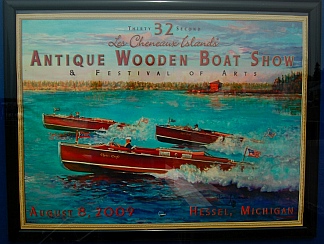
Hessel is the home
of a big antique
wooden boat show,
and we found a few
down in the
boatyard. Too
bad we wouldn't
be here in
August to see
the event.
A fellow at the
boatyard
proudly showed
us Shotsie, a
1942 Chris Craft that looks like it just came out of the showroom. The
rich varnish, immaculate engine and new-looking controls inspired
images of young people of another era enjoying an afternoon on the
water.
We strolled around the water's edge and admired several beautiful old boats. I can remember
boats like these (not quite as pristine!) from when I was a very little girl on the beach in New
England, and Mark remembers aunts and uncles taking him for rides in boats like these on Lake
St. Clair.
A little further north of Hessel, in Cedarville, we found the heart of this wooden boat culture: The
Great Lakes Boat Building School. Set in a huge barnlike building, the doors were thrown wide
to let in the sun and spring air, and we peeked inside.
Offering an intensive two-year
program, students attend all-day
classes five days a week (with
summers off). They range from
young people looking for career skills
to retirees looking for personal
fulfillment. The $10,000/year tuition
puts you in a class with just a handful
of other students, mastering this craft
under the attentive tutelage of highly
qualified instructors.
In Year 1, all of the students build
the same boat, a flat bottom
double-ended skiff, which the
school then sells when it is
completed. Selling these exquisitely crafted boats
supplements the school's income and helps keep the
tuition from being even higher.
There were boats in several stages of completion, and
outside was a gorgeous 32' boat that had taken two
different student classes two years to build.
The first class had laid the planks and shaped the hull,
and the second class had done the finishing work.
Now it was on a trailer, ready to go to Harbor Springs, home of the
lucky folks who had commissioned the school to build it.
Stopping for a snack, we discovered a local delicacy in the UP is
"pasties." I hadn't seen these meat-pie treats since I was in
Australia in the early 1990's. Down Under they call these yummy
personal-sized flakey crust encased meat and veggie pies "pahs-
ties." Here in the UP they were called "pass-ties" but they were the
same delicious mini-meals that were probably brought to both
regions by Cornish immigrants many years ago.
We drove straight north across the UP, making a bee-line for Lake Superior. The
temperature had dropped as soon as we crossed the bridge into the UP, and there were
snowmobile signs everywhere. We even saw someone wearing a t-shirt emblazoned with an
image of a snowmobile and the words: "Summer Sucks." This was Cold Country! Brrr.
There are endless paths through the woods where you can snowmobile in the winter, and lots of
wide open farmland as well.
Mark spotted two large
Sandhill cranes strolling down
the road. As with so much of
the wildlife we see, we tried to
get them to stop and pose so
we could get a clear photo,
but they had other ideas.
We had seen two of the Great
Lakes so far: Lake Michigan
and Lake Erie, and I wanted
to dip a finger in Lake
Superior. We drove straight
to the first coastal opening we
could find and ran down to the beach. A family was
coming up the trail from the beach, the kids shivering in
wet bathing suits with beach towels wrapped around them.
One little girl told us excitedly (through chattering blue lips), "I went in four times!" She was very
proud of her feat, and once I put a finger in I could see why. It was like putting your hand in the
water that collects around the ice in a cooler. My hand turned red and ached instantly.
I am sure the Lake Superior coast is stunning, but that little bit was enough for me. We turned
south and headed back to our cozy hotel overlooking the lighthouse in St. Ignace, planning our
next outing to the Soo Locks.