

Hat shop in Salmon, Idaho.

Trade-in hats from loyal customers.

Lemhi County Fair

Cowboys watch the rodeo.

Beautiful barn and ranch in the Bitterroot.

Little Buck eyes me up.

He did exactly as my reins told him.

A peaceful but busy ranch.

Calves come barreling down the chute to be
inoculated.

They are held in a small pen for their shots.
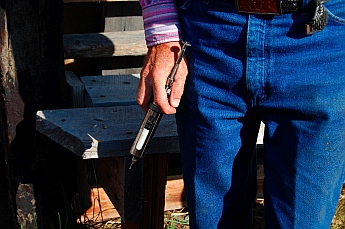
That's a mighty big syringe!

Two quick shots. Some calves barely seemed to
notice.

And off they run to join their waiting friends.

Sunset casts a warm glow on the Bitterroot mountains.

A wildfire had burned for a month in the nearby hills.

Carl shows us what ranchers do in their free time.

The views became more and more
grand as we climbed.

New growth from the wicked 1910 blaze to the left and
new charred scarring on the right.

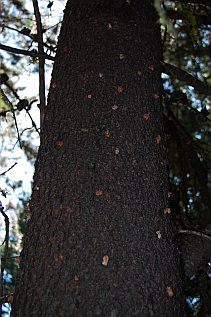
Beetles bore into the tree bark
and the tree responds by oozing
thick sap.

The newest ranch hand.

Wild turkeys pay us a visit.

Just a few feet to one side and we'd have had a good sunny
glimpse of the family.

Bambi trots across the grass nearby.

The cows come when called.

Yum, freshly mowed grass!

That's something to moo about.

The moms circle us.

A few treats to lure them in, and they know the next
step is a romp in a new pasture.

This guy was hopeful mom still had some milk for him.

And they're off to greener grass on the other side of the fence.
Stevensville, Montana
Late August, 2009 - We left Stanley, Idaho and continued traveling
north towards Montana, following the wonderful twists and turns of the
Salmon River as it descended down the mountains. During two days of
leisurely driving along the river's edge, we watched the terrain gradually
change from tall pines on steep mountainsides to rolling, barren hills that
seemed to have been shaped and smoothed with care. We slowly
began to feel the mood changing from fly fishing in fast-moving streams
under cool trees to ranching on the wide open range under the big sky.
Stopping in the small town of Salmon, Idaho, we found a shop filled with
cowboy hats. The new ones on the racks looked very crisp, but the
ones with real character were the crumpled ones the customers had
turned in. These hats lined the tops of the walls in the store. Each hat
was crinkled and worn in a different way, and each had the owner's
name under it.
Outside of town we found the Lemhi
County Fair in progress. There was
all kinds of horse activity going on,
and we watched a little as the riders
competed with each other to be the
fastest one to sort out a single cow
from the herd.
It was more fun watching the
cowboys watch the event.
Some of the ranches and farms we passed were beautiful properties. One red barn in
particular caught my eye, and later I found that this same barn
was featured on a glossy Montana calendar.
We went to Stevensville to visit our friends Bob and Donna Lea.
Before we'd even said "hello" to them, we met their horse Little
Buck. He was carrying Bob's ranching boots on his back.
I got a chance to try my legs at
riding a horse. This was just the
third time I'd been on a horse
since my first outing on a pony at
the church fair when I was five. I
managed okay, but I got the
signals crossed for turning right
versus left and consequently had
to duck under a very low branch.
Bob had work to do at his
neighbor Carl's ranch, and we got
a fantastic inside view of what
ranching is like. This was the day
the cows and their calves had to
be inoculated with two vaccines
and sprayed with an anti-fly
spray. I had no idea what to
expect, but I loved the sights and
smells and busy activity on the
ranch.
First the calves were sent down a chute to a single-calf sized holding
pen. There they were held in place with a clamp on either side of their
neck so they could bob their head up and down but couldn't wriggle out.
This made it easier to give them their shots. They didn't seem thrilled
with the idea, but they didn't protest too much. A scratch on the head
helped the medicine go down. Next, two ranchers lined up with the
shots. The syringes were pretty good sized. Bigger than I'd want,
anyways!
Then the vaccines were injected and
the calf was released to run off to his
friends down the hill. There was all kinds of mooing going on in the distance, as the calves and
cows had been separated from each other for this project, and they kept calling to each other
from their separate pens.
Eventually everyone got their shots
and later they all got their spray. We
had a chance to go through the
calving barn to see where and how
that is done (in March when it is zero
degrees and snowing). As I looked at
the apparatus for handling a breach
birth and for nurturing a sickly calf, I
was amazed at how much biological
and medical knowledge a rancher
needs to have. I missed most of the
scientific words Carl was throwing
around.
Yet there was a cozy intimacy to this family enterprise that brought a new group of calves into
this world each year. I felt like I was peeking in on a James Herriott story. In the distance that
evening the mountains were lit with a momentary splendor, adding a special glow to this world of
Montana cattle ranching.
A wildfire had been burning in the
nearby mountains for a month.
During the day you could smell the
smoke, and at times the fire danced across the mountainside,
sending up a ribbon of smoke first from one area and then another.
A few days into our visit a torrential rainstorm came, dropping an inch
of water on the mountains and valley (along with a thin layer of pea-
sized hail). That doused the fire long enough for us to take a
mountain bike ride up to a nearby peak to get a closer look.
Our new ranching friend Carl showed us that ranchers don't just raise
cattle. They mountain bike too.
Once we got up in the hills a
few miles we had an
expansive view of the
Bitterroot Valley below. We
met some US Forest Service
rangers at the crest of the
mountain, and they told us that
the fire was subdued but not
quite out. As we looked out at
the charred hillside in the
distance (on the right side of
the photo below) we could not
see any smoke just then, but
in later days it returned.
The modern wildfire fighting method is to let them burn, as fires are natural in this part of
the country. The hillside on the left of the photo shows the forest's re-growth since the
1910 inferno that roared from Washington state across Idaho and into Montana. The shorter, even trees covering most of the hill
are the regrowth and the taller, darker ribbon of trees that lines the ravine going down the hillside are the original pre-1910 trees.
One hundred years later and the evidence of that fire is still plain to see.
Hopefully the burnt areas from this year's fire will grow back
a little faster, as the fire was not hot enough to sterilize the
ground (like the 1910 fire did). All the fire talk aside, it was a
good moment for a photo op.
The fire was working its way across many healthy trees, but
we found ourselves in a stand of beetle infested trees. The
beetles bore into the bark and the tree tries to repel them
with thick sap. This gives the tree a pock-marked look.
Some trees are able to stave off the infestation, but most
Meanwhile, back at the ranch, Carl had just acquired an
adorable new cow dog. She was all cuddles and goofiness,
just settling in to her new home before learning the ropes of
her ranch job.
Out in the "wildlife sanctuary," a portion of the pastureland allowed to grow
wild, two families of wild turkeys showed up. They had been in the area all
summer and at one time numbered two adult females and 17 chicks.
We counted 15 chicks with
the moms, but couldn't get
them to stand still or pose for
us in the sunshine for a family
portrait. They ran across the
road in the shadows instead.
In the midst of taking way too
many photos of these
turkeys, I looked up and saw
Bambi running across the
field, white spots and all.
A few days later, Carl invited us
over to see a "cattle drive" at the
ranch. This wasn't the big round-
up you might imagine, but a simple
walk-through from one pasture to
another. The cows had made
short work of all the grass in their
current field, and when Carl called
to them, they came running.
He presented them with some
freshly mowed grass and they got
very excited. The mooing was
tremendous, and each cow came
bellowing over to us, calf in tow.
They all stood around us in a circle,
expectantly. He hand fed a few,
telling me some of the stories behind
each one. The bulls were lounging
under the trees in another pasture
way down the hill. It was like a boys
school and a girls school with each
waiting for spring time when they
could finally get together at the prom.
Each May he puts two bulls in a
pasture with 50 cows for 70 days. By
the end just about every cow is
pregnant and the bulls have a
lot of notches on their belts.
Some cows had been on his ranch
for 13 years, and others for just a
year or so, but each had a history
and a personality.
This big guy was still nursing (a
little old for that, perhaps!). He
spent quite some time going round
and round from teat to teat, quite
sure that there was something
there for him, but not finding what
he wanted. Finally momma just
walked off.
Carl led the cows and calves through the gate, and they went running down
the lush green hillside. They were delighted with their new digs. The grass
was tall and soft, and the view was superb. The cattle on this ranch have it
good.
We said goodbye to Carl, and took off with Bob and Donna Lea for the
annual Labor Day Helmville Rodeo.