
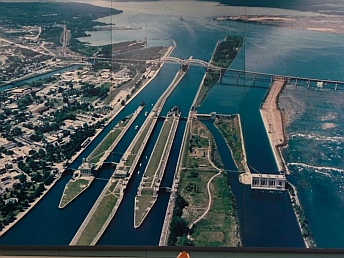
The Soo Locks are the four waterways to the left. The
largest lock, the Poe, is second from the left.
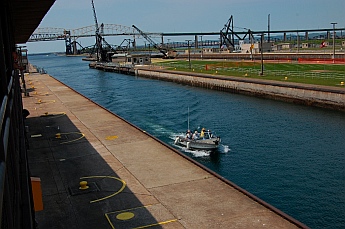
A small powerboat enters the lock from Lake Superior.
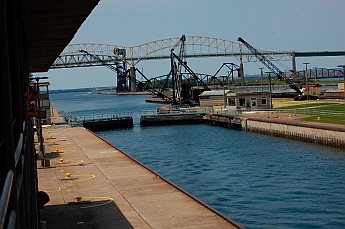
The gates close behind the boat so it is now sitting in
a private bathtub.
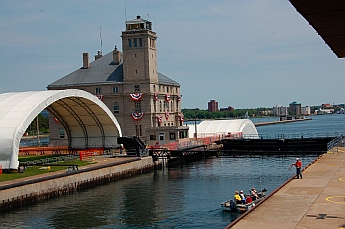
The boat takes a long line from the line handlers so it
can tie up to the side of the lock during its descent.
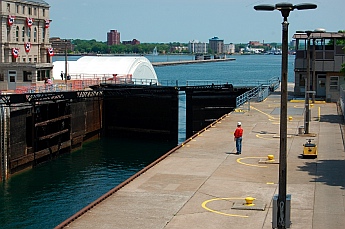
The water has drained out of the lock and the gates
open so the boat can emerge onto Lake Huron.
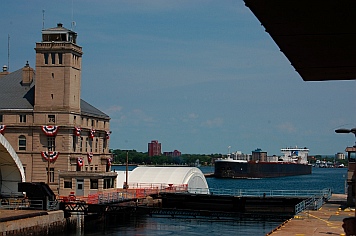
The 1,000' Walter J. McCarthy appears on Lake Huron
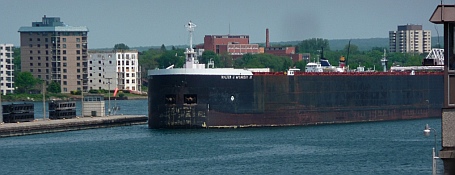
McCarthy aims for the Poe Lock which will raise it 21 feet to the level of
Lake Superior.
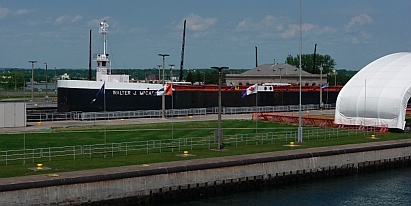
This is the biggest sized ship the locks can handle and it takes a
long time to get it situated in the lock.
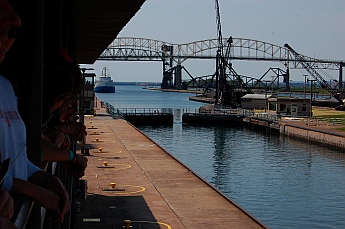
The gates open for Maritime Trader, a smaller 670'
freighter which has shown up on Lake Superior.
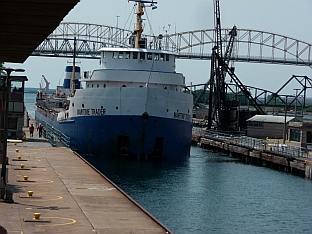
Maritime Trader glides into the lock.
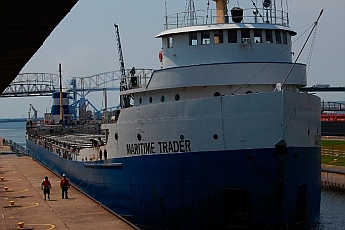
Line handlers appear on deck and on shore.
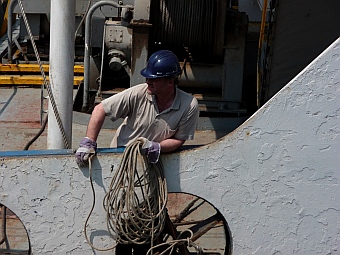
These guys make it look easy.
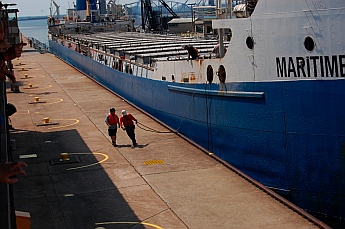
A line is walked towards the cleat on shore.
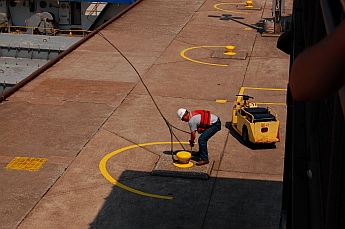
A line handler loops the line over a cleat.
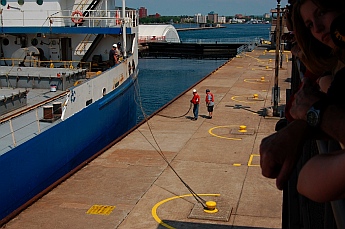
Additional lines are led to other cleats.
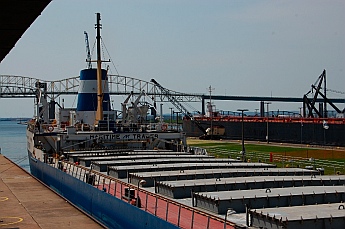
Almost ready to close the gates behind the Maritime
Trader, we can see the bow of the Walter J. McCarthy
in the next lock over.
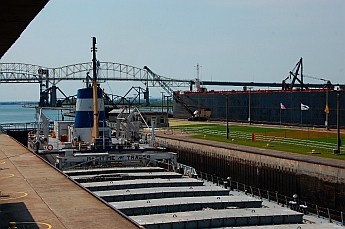
Maritime Trader begins its 21' descent from Lake
Superior to Lake Huron.
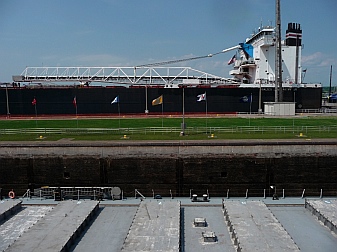
Meanwhile, Walter J. McCarthy is being raised 21'
from Lake Huron to Lake Superior.
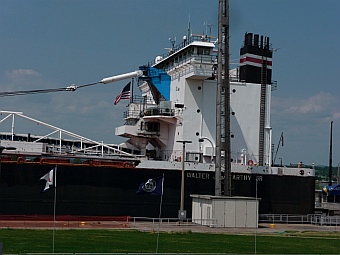
The bridge towers over the back end of the ship.
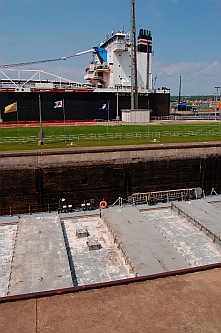
The McCarthy rises higher and
higher while the Maritime Trader
sinks lower and lower.
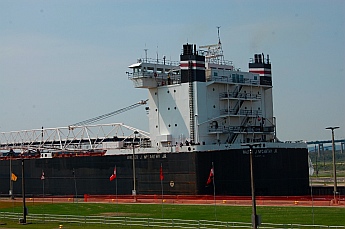
The McCarthy emerges through the doors of the lock
onto Lake Superior
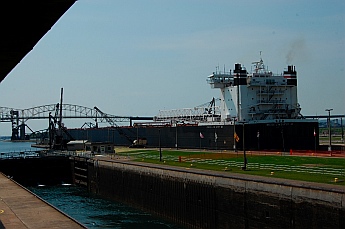
McCarthy steams off into Lake Superior.
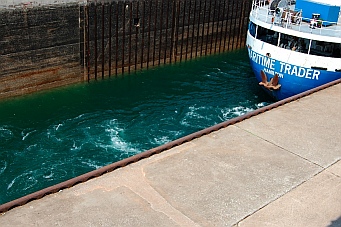
Meanwhile, Maritime Trader turns on its engines and
churns the water in its lock as it heads out onto Lake
Michigan.
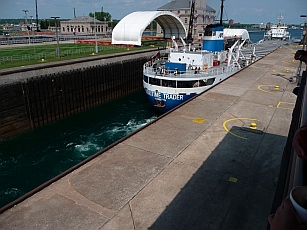
Maritime Trader heads off on the rest of her
journey on Lake Huron.
The Soo Locks: Lake Superior-Lake Huron, MI
Late June, 2009 - The maritime traditions run deep in the Great Lakes,
and after visiting the Hessel area and its many reminders of the wooden
boats of old, we took a trip to the Soo Locks where modern freighters
transit between Lake Superior and Lake Huron.
The Great Lakes offer a relatively easy way to transport goods from one
region to another. Some 11,000 freighters ply the waters each year,
moving tons of raw materials, mostly iron ore, coal, stone and grain (in
2008 shipping was down 45%). Lake Superior sits a little higher above
sea level than all the other lakes, and in the early days of the fur
trappers, the only way to get your canoe from Lake Superior to Lake
Huron was to carry it past the rapids of the St. Mary's River. This
method of "jumping" the river is said to have inspired the French to
name the area "Sault Ste. Marie" ("sault" meaning "jump"). In 1797 the
first lock system was built (on the Canadian side) so that ships could
float between Lake Superior and Lake Huron, and eventually the French
"sault" morphed into "Soo."
There is a fantastic visitors center and large viewing area at the Soo
Locks. As we stood there waiting for some action, suddenly a small
open powerboat with four people in it drove into the lock.
We watched with fascination as the doors slowly closed behind the little
boat and a line handler gave them a line to tie onto their boat.
Slowly the water in this bathtub-like lock began to drain out and the
little boat disapeared from view. The locks operate entirely on gravity,
as water either pours into the lock from Lake Superior or drains out of
the lock into Lake Huron. Eventually the gates opened at the other end
of the lock and we caught sight of the little boat motoring onto Lake
Huron. What a cool excursion for them! It had taken all of 15 minutes
or so, and we found out later that for recreational boaters transiting the
locks doesn't cost a dime. Just show up and the magic happens!
We were satisfied to have seen Soo Locks in action, and we were
about to leave when the lady at the visitors center said, "You really
should stick around. There are going to be two huge freighters in
these locks at the same time in about an hour." One of the ships
would be the 32-year-old, 1,000 foot freighter Walter J. McCarthy, one
of just forty ships of that size that works the Great Lakes.
Before long, the McCarthy showed up in the distance,
gliding towards us from Lake Huron. It would be
entering the Poe lock, the largest of the locks and the
second lock out from our viewing area. It was traveling
from Lake Huron into Lake Superior, so it would be
riding the lock system's "elevator" up 21 feet to the
level of Lake Superior.
It fit very snugly into the lock, and the handlers took an
especially long time getting the ship situated before they
closed the doors behind it. It looked to me like there was
barely a foot or two to spare between the two ends of the ship
and the doors at either end of the lock.
Meanwhile, the
Maritime Trader,
a smaller ship of
just 594 feet,
showed up in
the distance
coming in the
opposite direction
from Lake Superior.
The gates opened
and the ship slid into
place.
The line handlers on the ship and on
the shore loosely looped the lines
around enormous cleats. It all
seemed very casual and easy for
them, but the hundred or so people in
the viewing area were all hanging
over the railings, excitedly snapping
photos every few seconds.
Once positioned correctly, the doors
of the locks were closed behind the
Maritime Trader, the water began to
drain out of the lock, and the ship
slowly descended to the level of Lake
Huron.
Looking across the deck of the
Maritime Trader, we could see more
and more of the McCarthy in the
next lock as water filled that lock
and the ship was raised to the level
of Lake Superior.
Eventually, the water in the lock holding the McCarthy was even with
the water of Lake Superior, the doors of the lock opened, and the
freighter steamed out.
Simultaneously, the Maritime Trader had descended all the way
down, and the doors of its lock opened onto Lake Huron. The water
in the lock churned behind it as it started its engines and moved out in
the opposite direction onto Lake Huron.
A few days after we left the Soo Locks, construction crews
broke ground on a pair of dams that will hold back the waters of Lake Superior for the next few
years while the two oldest and smallest locks are rebuilt into a single brand new big one. Only
one of the three currently active locks can handle a 1,000 foot ship (the lock where the McCarthy
had been), so this new lock will allow more of the 1,000 footers to get between the two lakes.
Interestingly, the same thing is happening at the Panama Canal. Rather than three single lock
systems like the Soo Locks, the Panama
Canal is a huge system of three
channels that moves ships through a
series of 26 locks separated by a lake.
It takes the ships up 13 levels through
the first 13 locks, sends them across the
lake under their own power and then
lowers them 13 levels through 13 more
locks to the ocean on the other side. In Panama, a new lock system is
being built parallel to the other three to support the mammoth modern
supertankers that ply the world's oceans today.
Our visit to the Soo Locks capped off our time in the Upper Peninsula. It
was time to make our way south again, this time along Michigan's eastern
coast where we visited some choice shoreside spots along Lake Huron.