
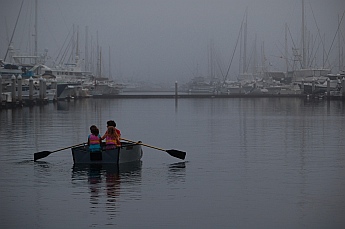
Fog greeted us most mornings.
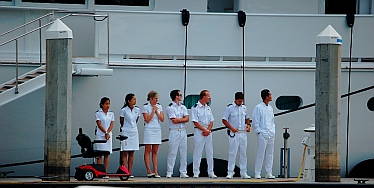
A megayacht crew forms a receiving line for the owners.
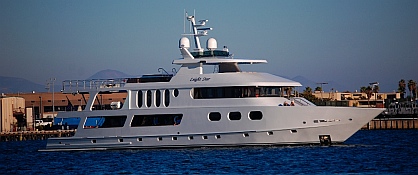
Leight Star - without its helicopter.
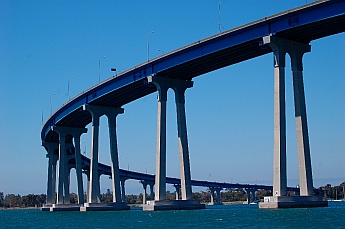
The Coronado Bridge.
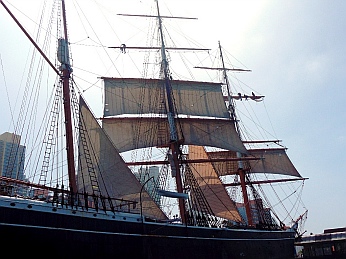
Star of India's sails go up.
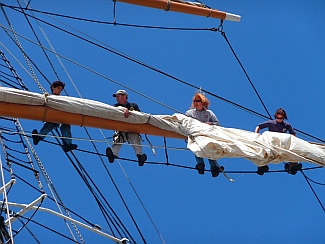
Brave crew members of the Star of India unfurl one
of the large square sails.
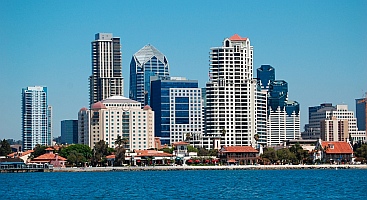
Downtown San Diego.
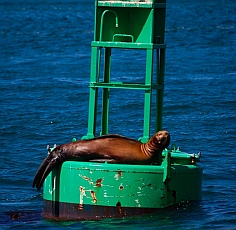
A harbor seal naps on a bouy.
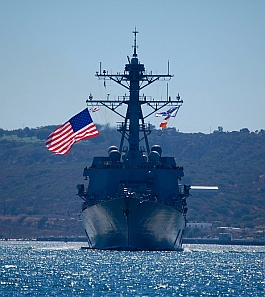
A warship cruises down the channel.
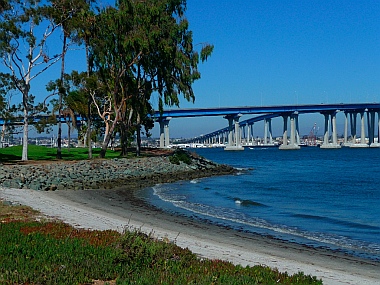
A beach on Coronado Island.
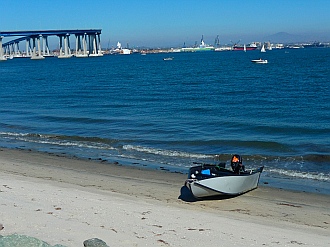
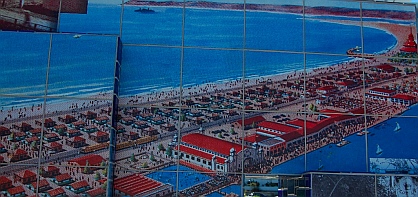
Coronado Beach Company's "Tent City."
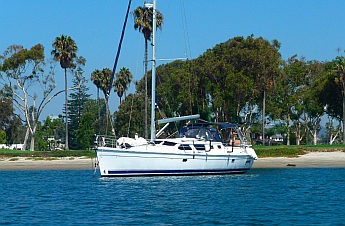
This could almost be a tropical isle.
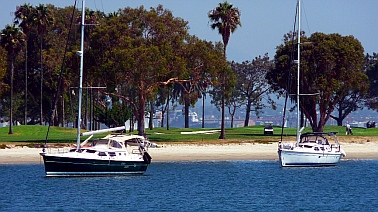
Friends on Hunter 44DS "Marina Bella" anchored nearby.
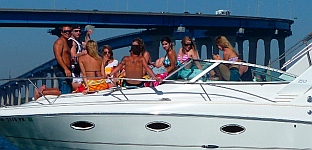
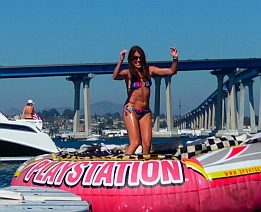
Party time.
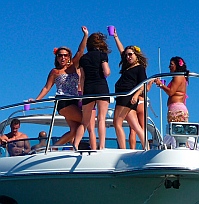
Woo Hoo!
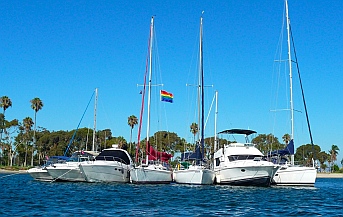
A raft up.
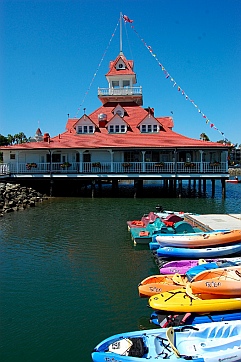
The Coronado Boat House.
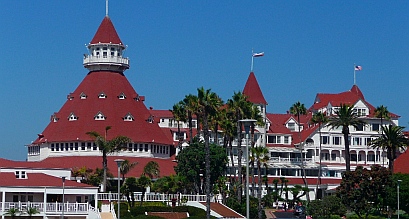
The Hotel del Coronado.
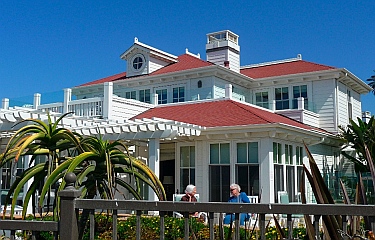
An elegant chat outside an elegant villa.
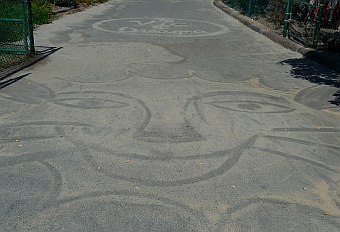
Sand drawing on the pavement.
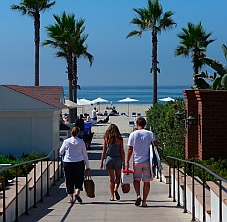
A perfect day for the beach.
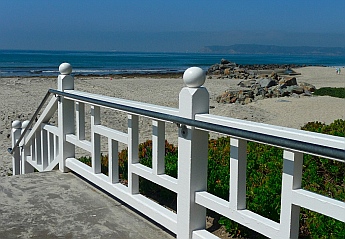
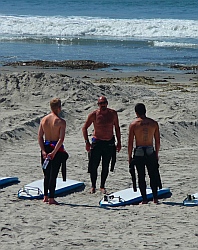
Coronado Beach is a classic California beach.
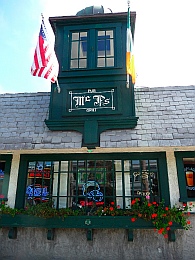
McP's, Navy Seal hangout.
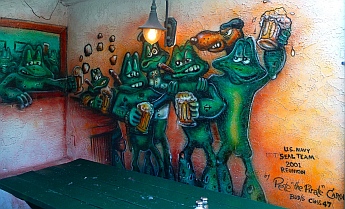
Navy Frogmen raise a pint at McP's. Painted by our
friend and anchorage neighbor, Pete the Pirate.
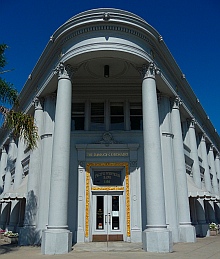
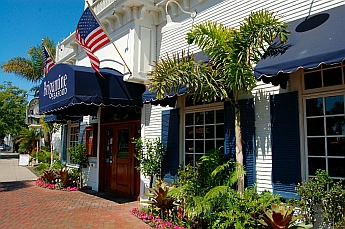
Quaint buildings line the streets on Coronado Island.
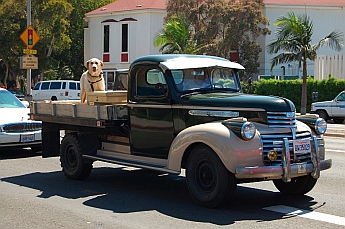
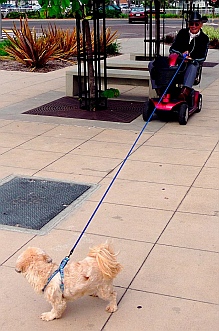
One dog power.
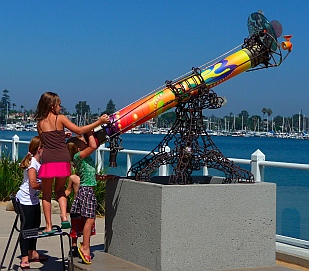
Waterfront kaleidoscope.
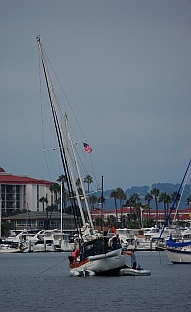
Glorietta Bay is surrounded
by shallow water.
San Diego Anchorages - Glorietta Bay
September, 2010 - We continued to shuffle between the various free San
Diego Anchorages, gaining new perspectives on the city with every stop.
Most mornings began with a cold damp fog that occasionally broke into
sunshine for a few hours on rare, lucky afternoons. By my reckoning,
summer began on August 16th, and after 10 stunning days of warm
sunshine and bright blue skies it promptly ended on August 26th. We
discovered that 2010 was the coldest summer in San Diego since 1933.
Brrr.
However, we thoroughly enjoyed the activity on the waterfront, regardless.
One of the joys of staying at the public Police Dock marina on Shelter
Island that is open to all boaters on a first-come, first-serve basis, was its
amazing variety of visitors. Long term cruisers heading north or south
would stop in, their boats laden with dinghies, liferafts, bicycles, solar
panels, wind generators and everything else necessary for a safe and comfortable nomadic life afloat. Next door to them would be
local liveaboards who were taking a break from their usual swinging spot on a mooring, using the convenience of the marina to
wash the boat, walk to the car, and luxuriate in hot, stationary showers in a space larger than a phone booth.
Right next door to the Police Dock is San Diego's ritziest megayacht
dock. So, while your transient Cop Dock neighbor tells you what a
steal he got on his ancient 25' sailboat (he just picked it up for $300,
and not only does it sleep four, making it a fine liveaboard home,
but it still floats), a few hundred feet behind him the seven person
uniformed crew of a megayacht stands in a formal receiving line to
greet the very old owner and his very young wife onto their palatial
yacht for the weekend. I can't think of too many land based
neighborhoods where the scruffiest scrappers and the most
supremely ultra-rich can practically reach out of their windows and
shake hands.
The megayacht Leight Star (140') made the news during our
stay because its very seasoned helicopter pilot crashed under
the Coronado bridge. Apparently he experienced a
mechanical failure shortly after taking off from the yacht, and
he didn't quite succeed in his attempted emergency landing on
the bridge. Fortunately, a rescue team just happened to be
nearby. They saved the 69-year-old pilot from the wreckage
and got him to the hospital right away.
Taking our dinghy across the bay to the Maritime Museum, we watched
the goings-on aboard the Star of India, a megayacht of sorts (205') from
another era. This beautiful ship is docked permanently along the
downtown waterfront, and it often sports a few flying sails. Way up in the
rigging we saw four daring crew members unfurling one of the square
sails.
Sadly, the Star of India had made the news just a month earlier as
well. A 68-year-old retired Naval officer who volunteered on the
ship fell 50' to his death while moving from a rope ladder to the
rigging on the forward mast of the ship. In a safety reminder to us
all, it turned out that his harness wasn't clipped in at the time.
As we wandered from anchorage to
anchorage we got to enjoy the stunning
skyline of San Diego's downtown district from
many angles.
The harbor seals didn't seem as impressed
by the view, and they lolled about, sleeping
soundly on the bay's bouys.
San Diego is a busy, active harbor, and more
often than not, while transiting the bay, a
warship will make an appearance. You can
hear these guys on the radio first, warning all
mariners that they are coming. When they finally slip by, their sheer size and intense
purposefulness makes them very intimidating.
Coronado Island is the bulb at the end of the peninsula that
essentially forms the outer arm of all of San Diego harbor. This
"island" is not to be confused with the four Coronado Islands that
lie offshore of San Diego just over the Mexican border. Ringed by
beaches -- both docile ones on the bay and surf-pounded ones on
the open ocean -- San Diego's Coronado Island is extremely
inviting.
We learned that back in the early 1900's the entire peninsula was
loaded with little beachside shanties. Initially the structures were
simple canvas tents clustered together to form "Tent City." A few
years later these little bungalows sprouted thatched roofs and
$1.50 per couple per night price
tags. You could get a deal if you
brought your family for four
months during the summer. It
seems that all of San Diego's
party crowd came out to Coronado Island for beach, sun and surf.
The Community Center park has a heartwarming outdoor display of photos, showing long
deceased revelers enjoying
this wonderful area when the
only roads were dirt. The
women wore long, lace
trimmed dresses at the turn
of the century and shifted to
flapper, tube-style dresses in
the 1920's. Every cheek-
by-jowl bungalow door
was framed by two camp
chairs. Today the area is
dominated by high-rises.
The Glorietta Bay anchorage is
tucked into a nook on the bay
side of the island. The sandy
beach is lined with palm trees,
making it look almost tropical.
Our friends on "Bella Marina," a
beautiful dark green Hunter
44DS anchored nearby, and the
two sisterships swung in unison for an
overnight, undoubtedly swapping stories
about their owners.
The clothing may have changed between
1900 and 2010, but the spirit of partying in the sun is just the same as it
ever was. San Diego erupted in warm sunshine and sparkling water for
the afternoons we were at Glorietta Bay, and the party boats just kept on
a-comin'.
Lots of beer and lots of skin brought the bay to life.
Behind us a group gathered in a seven boat raft-up. By tying the
boats to each other, with three boats dropping their anchors to
hold the group still, everyone could scamper from boat to boat,
enjoying a party aboard one boat on one night and on another
boat another night.
Coronado is soaked in history, and two old landmarks still
stand as reminders of the past. The Coronado Boat
House, built in 1887, perches on the edge of the bay.
Today it is home to a fine restaurant and a boat rental
business.
More dramatic, the Hotel del Coronado anchors a classic California beach. With red
turrets and lots of dormers, the hotel is a charming historic landmark. Walking along its
perimeter we came across two old ladies chatting in on a villa patio. They added to the
Hotel's "last century" air.
Offering more of a youthful
spirit, someone had created
sand swept images on the
sidewalk. Walking delicately
across a smiling sun face, it
seemed the artist was as happy
about this brief turn in the
weather as we were.
A little further on we found ourselves behind some beach-goers. What a
perfect day to take a beach chair, towel and book to the beach.
For me, Coronado Beach is what I always imagined a
California beach must be like, and the throng of Asian tourists
taking photos of each other with the beach and ocean in the
background confirmed that others must feel that way too.
Coronado Island has a busy main street where the boutique
shops and outdoor eateries spill out onto the sidewalk all the
way down the road. Everyone was out for a late Sunday
brunch as we strolled along, but we were ready for an early
pint at McP's. This is a special bar where the Navy Seals
hang out, and with a parental connection to the Navy we had
to check it out.
Also, our neighbor in
the A9 Cruisers'
Anchorage, former
Navy Seal "Pete the
Pirate" on the motor
yacht "Patriot Seal,"
painted the beer
hoisting frogs on the
wall of the bar.
Although originally
nicknamed "Tent City," Coronado was created by the
Coronado Beach Company as a master planned resort
community in the late 1880's, and the area remains very
upper crust today. Ornate business buildings and
carefully crafted shop buildings give the area a precious,
studied charm. We wandered through the back
neighborhoods, all very quiet, where each home is an
exquisite display of architectural flair.
Back on the boardwalk, returning to the boat, an old man
in a wheelchair gave us a huge smile. "One dog power,"
he said, pointing to his dog who was on his leash ahead
of him. Nearby, a trio of little girls clambered all over a
huge, colorful kaleidoscope.
When our weekend on Coronado
Island drew to a close, we motored
back to our home base at the A9
Cruisers' Anchorage off of Harbor
Island in the bay. Glorietta Bay is
flanked by shallows, and a hapless
ketch ran aground on the way in just
as we were leaving. The tide was still
falling as we passed them, giving them
few options until the tide came in again.
Meanwhile, on the radio, we heard the
Coast Guard simultaneously dealing with
two emergencies, a sailboat that had lost
power near the rocks of Point Loma and a
power boat that suddenly sank out from
beneath three older men. While the sailboat
dropped anchor and awaited a tow, the three
men in the water miraculously kept their
handheld radio dry and followed detailed
instructions from the calm Coast Guard lady on
the radio. As we went about our business
setting our anchor, we marveled that such a
tranquil morning in such a beautiful place could
yield three crises in a matter of minutes.
There is always a lot of action on the water.
Unfortunately, during the next few weeks, bad
weather and boat outfitting projects prevented us from further forays around
southern California, but on November 2nd we left San Diego permanently to sail