
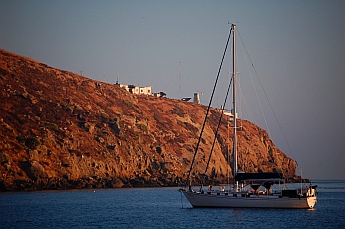
Isla Coronado Sur
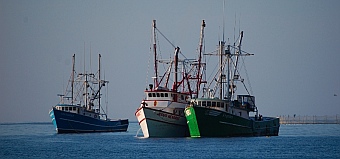
Fishing boats rafted at the Coronado Islands.
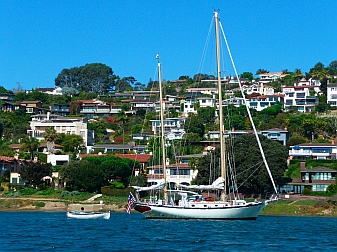
A ketch anchored at La Playa Cove.
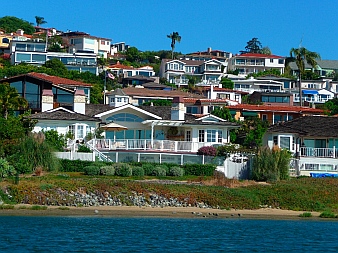
Beautiful mansions cover the hillside at La Playa
Cove anchorage.
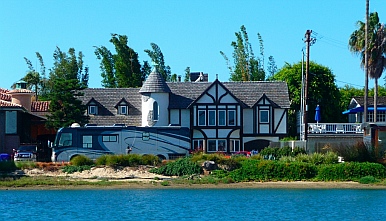
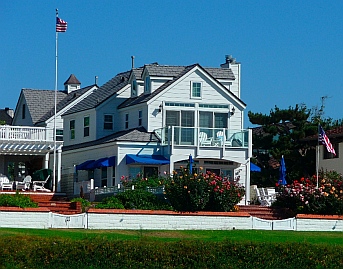
We decided this was our favorite house.
The roses smelled so sweet too.
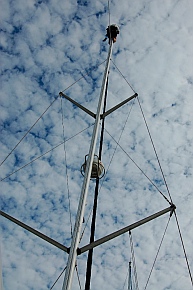
Mark changes the bulb for our
anchor light.
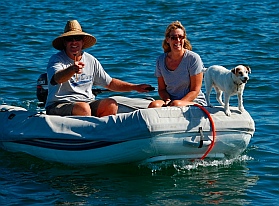
Folks of all kinds enjoyed La Playa Cove for
the weekend.
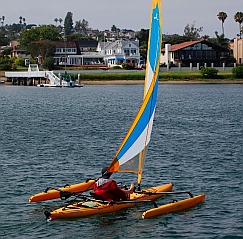
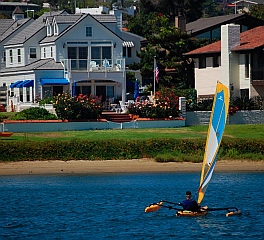
Hobie's slick trimaran sailing kayak.
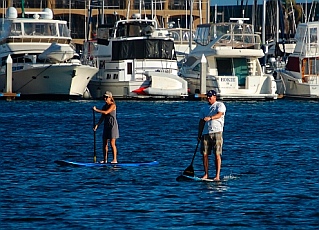
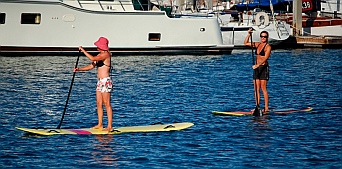
Segways of the sea.
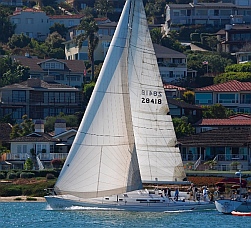
"Sure, I can squeeze through there."
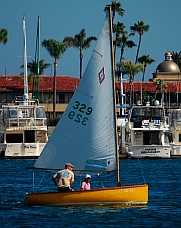
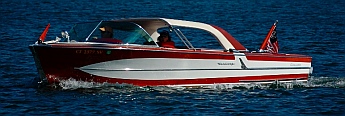
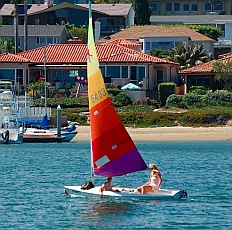
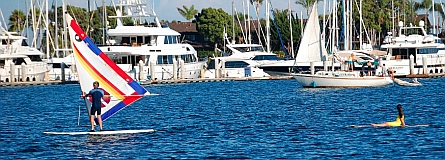
A surfer gets a tow from a windsurfer.
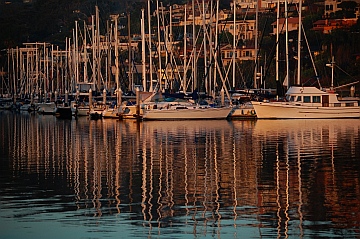
Morning dawns at Southwestern Yacht Club.
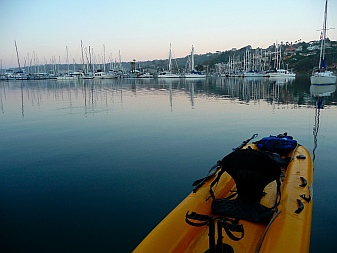
Our kayak became our lifeline to shore.
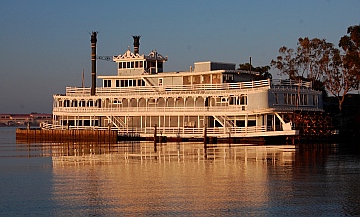
A closed paddle-boat restaurant fills our view at the A9
cruisers' anchorage.
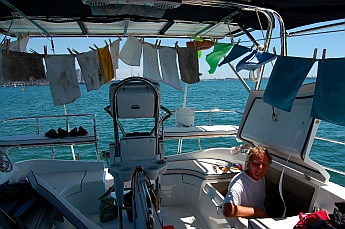
Those dirty towels sure pile up on a boat.
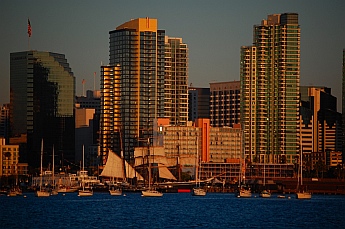
Sunsets from our cockpit were a little slice of heaven.
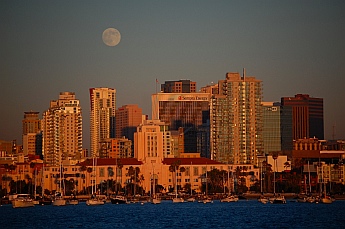
The full moon hovers over downtown, serenely
keeping an eye on the chaos of humanity below.
San Diego Anchorages
Late August, 2010 - We pulled out of Baja Naval marina in Ensenada,
Mexico after a flurry of paper chasing to get our exit documents together
in a form that was acceptable to the Port Captain. The position of Port
Captain carries a lot of prestige, and he or she holds ultimate power over
all boating activity in the port. Having checked into Mexico through Hotel
Coral & Marina, the Ensenada Port Captain told us we now needed our
exit crew list to be written on the letterhead of Baja Naval Marina, to show
our movement from one marina to the other during our stay. Good grief.
The cruising guide had indicated we could write up our exit crew list
ourselves. No such luck. Lots of boats leave Mexico without getting exit
papers, but because we plan to return in a few months it seemed wise to
follow the prescribed protocol, so we put a few miles on our shoe soles
that morning as we ultimately made three trips to visit the Port Captain.
The morning was misty, and the sea created a smooth, undulating
blanket beneath us as we motored into the sunny haze. We planned to
stop at Las Islas Coronados for an overnight rather than do the entire 70
mile trip to San Diego in one shot. These islands are a few miles
offshore from Mexico, lying just below the US/Mexico border. We had
heard to steer clear of the fishing activity at the south end of the
southernmost island before turning in to the anchorage that lies at its
midpoint on the eastern shore. So we were very surprised to find that
fish pens and fishing boats occupied the entire eastern shoreline of the
island, effectively blocking us from turning towards our planned
anchorage until we got all the way to the northern tip.
Doubling back south and snaking our way along the shore, we eyed the
eight or so rows of three or four fish pens per row. A lone sailboat was
anchored amid 30 or so fishing boats, and we took a spot nearby. It is a
pretty little anchorage, and when morning came we didn't want to leave.
The gulls were calling each other, seals surfaced here and there around
the boat, and the rocks glowed orange in the sunrise. Facing the hustle
and bustle of San Diego did not seem appealing at all. Being anchored,
and free, after months of harnessing our boat in a slip, tying it down like a
horse penned in a stall, this brief whiff of pure freedom beckoned us. After
all, opening our souls to this world of nature is why we chose to get a boat
and go cruising.
However, our
truck was parked
in 72-hour on-
street parking on Shelter Island and it was now 96 hours since we'd
parked it. Duties and obligations reeled us in, and we sailed into the US
customs dock in San Diego and filled out more paperwork for more
uniformed officials to document our arrival back in the US.
Our arrival coincided with the arrival of summer in southern
California, despite it being August 17th. The sun shone from first
light every day for ten straight days, and it seemed like it must be
June.
We spent a few errand filled days tied up at the harbor's Police
Dock, taking advantage of having easy access to our truck and
stores from a slip in the heart of San Diego's sailing community.
We were in an intermediate phase now, without a permanent slip
for the boat, but not yet cruising full-time without wheels on land.
Our plan was to hop between anchorages until mid-October,
finishing our various outfitting projects on the boat and learning to
live on the hook, before setting sail for southern Mexico.
One delightful free anchorage is
available--weekends only--at La
Playa Cove behind Shelter Island. Tucked between the
San Diego Yacht Club docks and the Southwestern Yacht
Club docks, this pretty spot is hugged by a hillside
studded with multi-million dollar waterfront homes. As we
swung slowly from side to side at anchor, we admired
these beautiful glass-walled mansions, imagining what
that life must be like.
Shelter Island had unexpectedly become like a second
home to us after we spent October, 2008 and half of
January 2009 parked along the streets in our fifth wheel.
So we enjoyed getting to know its other side, soaking up
its unique warmth and familiarity from the water.
Our first anchoring experience at Isla Coronado Sur on the way to San Diego had revealed that
our anchor light bulb at the top of the mast needed changing. It took two sailors to change this
light bulb, one manning the winch (me) and one scurrying up the mast to change the
bulb (Mark). What crazy stuff this boating life gets you into.
Being the first truly
gorgeous, sunny, warm
weekend of the summer,
the cove was soon filled
with merry-makers of
every type. If you had
something that could
float, this was the
weekend to take it out.
We saw rubber dinghies,
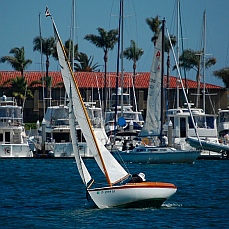
sleek little sailboats, a
Hobie sailing trimaran
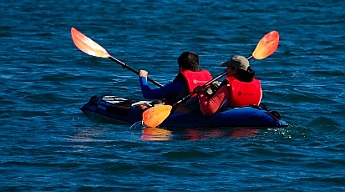
kayak, traditional
kayaks and even folks
who could walk on water.
These standing paddlers
are like Segway riders of
the sea.
Lots of hot shot sailors
came through the
anchorage in impossibly
large boats, weaving
between everyone under
sail power alone,
showing the world just what amazing sailing skills they
have. It was a little unnerving when a single guy showed up in a
ketch, a sailboat with two masts and three sails, all flying. For a
moment the bowsprit on his boat threatened to hole Groovy right
through the middle, but he turned just in the nick of time and anchored
perfectly, running his engine for less than three minutes as he
dropped the hook.
Big kids, little kids, kids who ride on boats -- all love La Playa Cove.
During this time we gradually adapted to our new life at anchor. No
longer able to simply step ashore and walk a few paces to our truck,
we now had to get ashore by boat. We used the kayak at first, as it is
just so much fun to run around in. Getting into the kayak from the
back of Groovy can be tricky, since both boats move, and not always
in a synchronized manner.
Ferrying family and friends
to the boat was a new
experience too. Since the
kayak is built for two, and
two only, each visitor had to
be brought aboard one at a
time. And a ride in the
kayak is never a dry affair. Wet butts, wet feet, and salty hands were the name of the
game, but it was all such a blast.
When the weekend ended Monday morning, the boats
slowly drained out of the anchorage and we headed
over to our new home base, the A9 anchorage off the
end of Harbor Island. This anchorage is free to all non-
San Diego County residents, and you can stay for up to
90 days, renewing your 30 day permit twice. Not quite as picturesque as
La Playa Cove, it is still a very pretty spot. Situated behind a now-closed
paddle boat restaurant and very upscale marina, it lies between the San
Diego airport and the Navy's airbase with a great view of downtown.
There is a constant stream of planes coming and going on either side,
and boats of all sizes ply the harbor's waters. Tankers, cruise ships,
Navy ships and sunset cruise boats come and go all day long, and
between them the pleasure boaters fly about at full speed in power boats
and at half speed in sleek sailboats.
We loved our new spot and continued to adjust to this new life on the hook. I did a load of laundry by hand, to alleviate the huge
pile-up of dirty clothes that would require a trip ashore by boat to get to a laundromat. We found little things that were trivial in the
fifth wheel or living at a marina, like getting groceries or disposing of garbage, now became Major Expeditions. Every trip on or off
the boat required a kayak ride and we got used to hugging our groceries and balancing bags of trash in our laps as our legs
pushed the pedals.
Mark continued working on the
various projects he'd tackled to get
ready for long term cruising in
Mexico. Access to the truck was
both a boon and a bust, as it needed
to be moved from Shelter Island to
Harbor Island, a distance of several
miles. Not a big deal for the truck,
but the kayak on the other hand...
Mark's legs were sore after soloing
the kayak against wind and current
while I drove the truck around to
meet him.
Late afternoons in the cockpit were
pure heaven. We would kick back
and watch the scene around us.
Jets arrived in regular one minute
intervals to our left, the coast guard
choppers hovered over their base
just a little further on, and the Navy
jets exploded into the skies across
the harbor on our right. It wasn't a
tranquil anchorage, but the hum of
human activity was intoxicating in
its own way.
What a surprise it was, as we sat
there one afternoon, to see the full
moon suddenly appear above the
city skyline right in front of us.
Mother Nature still sets the stage for
all human activities, even in our
biggest cities. It hovered and winked
over the glowing buildings, welcoming
us to our new life of boondocking on
the water. Happily, many more
enjoyable days in San Diego's
anchorages lay ahead of us.