Pacific Baja
Highway to Mexico's cruising grounds
North Pacific mainland coast.
The bridge between the Sea of Cortez and the southern Pacific coast.
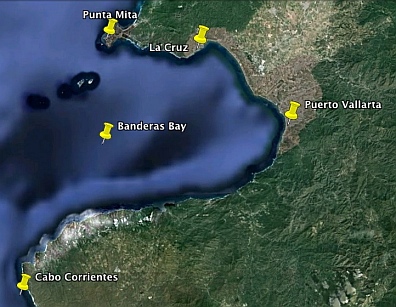
Banderas Bay
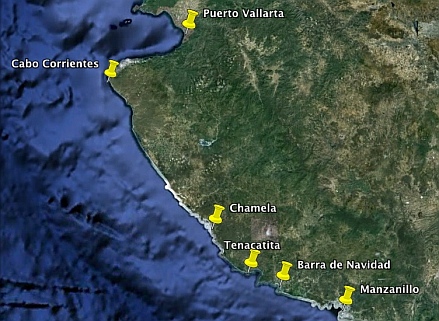
"Costa Alegre" - the "Cheerful Coast" - Chamela to Manzanillo.
The northern part of a popular Mexico cruising ground.
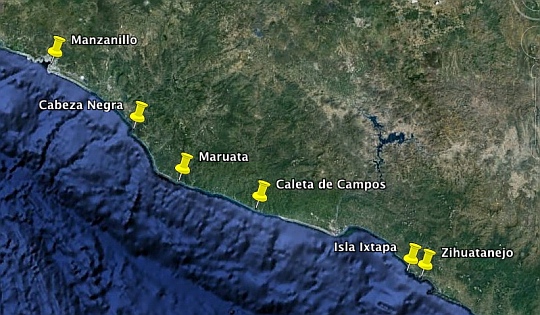
Costa Grande - the "Big Coast" - Manzanillo to Zihuatanejo.
The southern part of the premier cruising grounds on Mexico's Pacific coast.
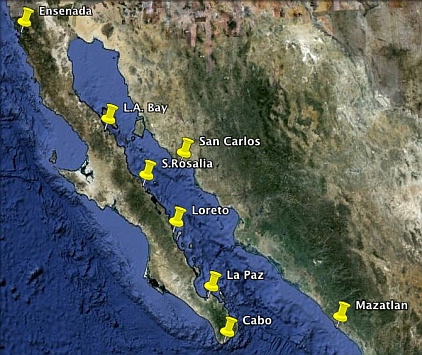
Sea of Cortez.
Called "the world's aquarium" by Jacques Cousteau.
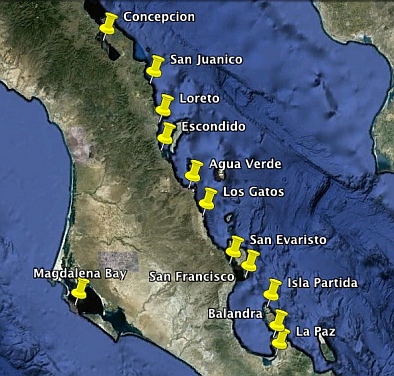
Southern Sea of Cortez.
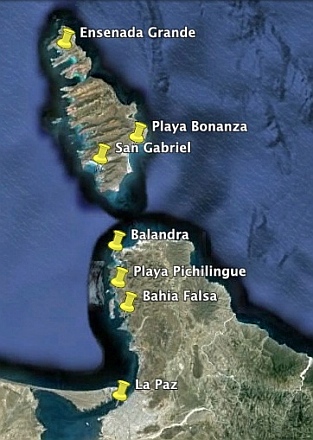
La Paz Anchorages, Sea of Cortez.
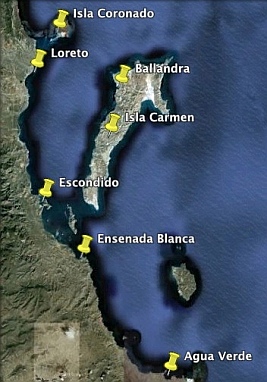
Loreto - South Anchorage, Sea of Cortez.
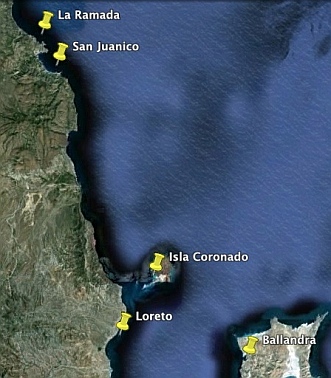
Loreto - North Anchorages, Sea of Cortez.
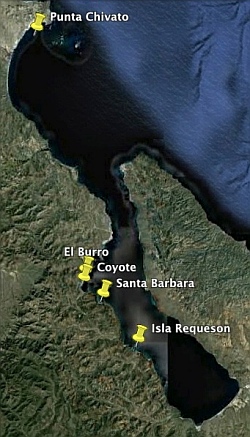
Bahía Concepcion, Sea of Cortez.

S. Mexico / Guatemala / El Salvador / Belize
Maps of Mexico for Cruisers: Pacific Coast & Sea of Cortez Anchorages
This page contains detailed maps of the west coast (Pacific coast) of Mexico, including the most popular cruising anchorages
and destinationa. If you are planning a cruise to Mexico on your own boat, be sure to check out Mexico Cruising Tips (1) and
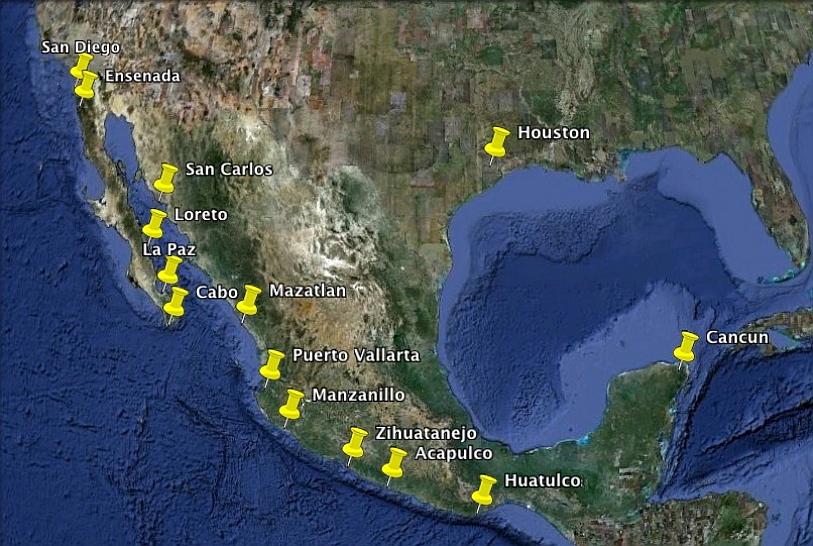
Coastal Mexico can be thought of as having four different primary cruising regions. As we traveled along the coast we
encountered them in this order (links go to our pics and stories):
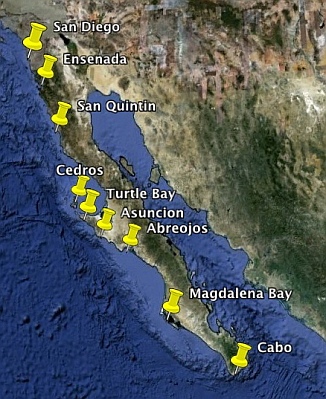
● The Pacific coast of the Baja peninsula that runs down the western side of Baja from Ensenada to Cabo San Lucas.
● The northern Pacific mainland coast between Mazatlan and Manzanillo, including the Costa Alegre (or "Gold Coast")
which extends along the Pacific mainland's southern coast below Puerto Vallarta
● The Southern Pacific mainland coast which runs from Zihuatanejo/Ixtapa to the Guatemala border.
● The Sea of Cortez where the majority of the beauty lies along the eastern shore of the Baja peninsula.
PACIFIC COAST OF BAJA
For cruisers, the 750 miles long Pacific side of the Baja coast is like a
highway to the prime Mexican cruising grounds. It is predominantly a
downwind passage, as the prevailing winds come out of the northwest.
However, these are not consistent winds, and we found ourselves on all
points of sail and frequently motoring because the wind was too light to
sail. The current and swell also move down the coast, so we were
swept along whether under power or sail. The trip back up this highway
is called the "Baja Bash" because it is against the winds and currents
and folks usually make the journey in the spring when the winds are
strongest, resulting in a very uncomfortable trip.
NORTH PACIFIC COAST
Mazatlan - Manzanillo
Mexico's best cruising grounds lie in the Sea of
Cortez to the north and along the Pacific mainland
south of Puerto Vallarta. Most of the northern
portion of Mexico's Pacific coast is like a bridge
between these two areas, bounded by a triangle
between the major cities of La Paz, Mazatlan and
Puerto Vallarta, each home to good marinas. The
scenery, layout and quality of the anchorages
relegate this region (in my mind) to being less of a
cruising destination and more of a cruising transit
zone to get between the Sea of Cortez and the
southern Pacific coast cruising grounds, or a "live-
aboard" zone where many cruisers spend months
at one marina or another rather than cruising
between anchorages. Unlike the Sea of Cortez
and the southern mainland Pacific coast, the
distances between the more charming anchorages
of this region are quite long, often requiring an overnight trip.
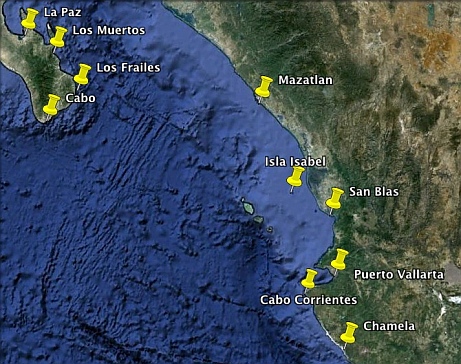
Most Sea of Cortez crossings take place in this region. The shortest distance is 165 miles between Los Frailes on the eastern
tip of Baja and Mazatlan. The longest passage is 330 miles between Cabo San Lucas and Chamela Bay on the mainland. The
seas in this region can be confused, steep and choppy, as it is the meeting place for the Pacific Ocean (sweeping around Cabo
and up from the southwest) and the Sea of Cortez (rushing down from the northwest). This is particularly true when you travel
the line between Cabo and Chamela, as we found out during 55 hours of being tossed about. In addition, there is a strong
"cape effect" of powerful winds and seas off the cape that juts out between Puerto Vallarta and Chamela, called "Cabo
Corrientes." Passage around this point is best done overnight or in the early morning and at least 5 miles offshore.
Banderas Bay / Puerto Vallarta
Puerto Vallarta is at the eastern end of the 60 mile coastline
of Banderas Bay that cuts into the mainland here. Four major
marinas dot this bay and there are a few anchorages on the
bay's north and south coasts. Further north, Mazatlan also
hosts several marinas and some anchorages nearby.
Costalegre / Gold Coast
An attractive cruising ground on the mainland Pacific coast of
Mexico starts in Chamela and continues southeast to Manzanillo. This
area is known to cruisers (especially readers of Pat Rains' Mexico
Boating Guide) as the "Gold Coast." The Costa Alegre includes about
ten anchorages in the fifty mile stretch between Chamela Bay and
Manzanillo Bay. Some anchorages are along beaches that have
little development. Some are on or near busy little tourist towns
full of boutique shops and restaurants. Some front posh resorts,
a few of which welcome cruisers.
In the wintertime the water can hover as low as the low 70's and
the air in the low 80's. Water clarity varies from year to year, with
some years having enough visibility to snorkel and others being
so murky with red tide that you can't swim or make water in the
anchorages. Many anchorages are near fresh water estuaries
that empty into the ocean, further muddying the water. However,
the exuberance and warmth of the local people and the wide
variety of sights to see make for a wonderful stay in this area.
* * * HUATULCO IS THE BEST CRUISING GROUND * * *
* * * IN ALL OF MEXICO!!!!. * * *
SOUTH PACIFIC COAST - Costa Grande & Costa Sur
The Costa Grande runs south of Manzanillo with the major stops being at Zihuatanejo and its little vacation paradise island, Isla
Ixtapa (labeled "Isla Grande" on some nautical charts). The 200 mile distance between the wonderful anchorages in Manzanillo
Bay and Zihuatanejo Bay is broken up with three anchorages that most sailors skip because they are so rolly that sleep is nearly
impossible. Their logic: if you aren't going to sleep at anchor, you might as well be making miles on your way to your
destination. Although there are really only a few locations to drop the hook, the town of Zihuatanejo and its sophisticated big
sister city of Ixtapa offer enough to keep cruisers busy for weeks. Winter water temps hover in the mid- to high-70's and the air
in the mid-80's.
The Pacific Ocean crashes into the Pacific coast of Mexico (both Baja and the mainland) after traveling thousands of miles,
rendering all Pacific coast anchorages in Mexico (except Barra de Navidad) somewhere between "rather rolly" and "very rolly."
Ordinary walking and moving about the boat becomes a crazy duck wobble. The prevailing winds blow from the northwest,
parallel to the Pacific coast, and most anchorages are wide open bays with wonderful surf-filled beaches. In each one, a small
point juts out into the Pacific at the northwest end of the bay or beach. Tucking in behind this point gives some wind protection,
but the swell usually sneaks in, hitting the boat on the beam. Setting a stern anchor so the boat faces the swell can help, but the
easiest way to avoid the rolly anchorages is to stay in marinas. Many cruisers spend much of their winter cruising season
sampling the lovely Pacific coast marinas.
SEA OF CORTEZ
In this modern era of cruising, an easy way to find the finest
"vacation quality" cruising grounds worldwide is to see where
the Moorings has their charter boat bases. The Moorings
base in La Paz is at Costa Baja Resort Marina, officially
granting this cruising area the status of "excellent." The Sea
of Cortez offers clear turquoise water, abundant wildlife,
exotic desert scenery, and remote anchorages, but it is a
seasonal destination.
The Sea is most popular in
October/November and April-
June, when air temps are in the
80's to low 90's and water temps
are in the low-70's (spring) to
low-80's (fall). Winter is cold:
overnight low temps dip into the
high-40's and low-50's and water
temps fall to the mid-60's.
Summer is hot: air temps rise to
the low-100's and water temps
can reach the low-90's. It is
because of these extreme hots and colds of
summer and winter that most cruisers visit
the Sea of Cortez in the spring and fall. The
favored cruising area is from La Paz north to
Santa Rosalia.
Although the Sea of Cortez is very beautiful
in a rugged and wild kind of way, it is also
subject to severe weather. The saying goes
that for two days of paradise you pay with
one day of hell. The hellish conditions are
brought on by sudden winds and steep
waves that can overpower an anchorage,
either pushing the boat
towards a terrifying "lee
shore" or subjecting it to a
violent beam sea.
The La Paz area offers a lot
of beautiful anchorages within
a 1-4 hour sail of the city.
Most of these are open to the
west and southwest which makes them very vulnerable to the nighttime 25-knot
southwest Coromuel winds and steep waves that blow from dusk til noon in the spring
and summer. They are also subject to Westerlies that blow in during the night like
Coromuels. Light Westerlies combined with a north swell puts the swell on the beam,
creating a rolly night. Many anchorages are also subject to swell during Northers, as
the swell wraps into the anchorages from the west while the boat is held facing north,
making it hit the boat on the beam.
Northers are 3-day 25-35 knot winds that
occur between November and April. In La
Paz harbor a chop develops and boats do
the "La Paz Waltz" where they tend to
swing in different directions and
sometimes bump each other due to their
different responses to wind and current as the tide sweeps in and out of the long
channel. The best protection in a Norther is Bahia Falsa, as the swell tends not to
wrap into the anchorage.
The Loreto area is many cruisers' favorite part of the Sea of Cortez. The sailing
within the bay between Loreto and Isla Carmen can be truly delightful with good wind
and flat seas. The anchorages are scenic and they are close enough together and
varied enough in orientation that if the conditions are bad in one anchorage they are
bound to be better in another. In addition, it is easy to anchor off Loreto in light
conditions, walk into town, and do extensive provisioning for the boat.
Bahía Concepción is a very large enclosed bay that offers pretty and lightly
populated anchorages and flat seas. The ex-pat community is enormous. All of the
beach bungalows on El Burro Cove and Playa Coyote are owned by non-Mexicans.
It is still a remote area, however, where land dwellers get their electrciity from solar
power and wifi internet is hard to find. The bay can be very hot in the summer, as
there is much less breeze within the bay than in other anchorages elsewhere that
are open to the Sea of Cortez.
INLAND: S. MEXICO and N. CENTRAL AMERICA
For cruisers, southern Pacific Mexico is defined by the Gulf of Tehuantepec, a 200 mile wide bay between Huatulco (Marina
Chahué) and Puerto Chiapas (Marina Chiapas). Both marinas are ideal places to leave the boat to explore inland.
From Huatulco, the colonial city of Oaxaca and the Zapotec ruins of Monte Alban and Mitla are an 8 hour bus ride away.
From Puerto Chiapas, the colonial city of San Cristóbal de las Casas is a 9 hour bus ride away. From San Cristóbal, Mexico's
crown jewel of Mayan ruins, Palenque, is a 5 hour bus ride away (don't miss Yaxchilan and the Agua Azul waterfalls when you
are there!).
From Puerto Chiapas a tour of Guatemala
can also be undertaken, starting with an 8
hour bus ride to Guatemala City followed by
a 45 minute taxi ride to the colonial city of
Antigua, Guatemala.
All of these travels go through extremely
mountainous terrain which is why the bus
trips take so long. The distances are not
that far. For instance, it is just 200 miles
from Puerto Chiapas to San Cristóbal, but
the roads are tiny, full of hairpin turns and
speed bumps. Lots little towns crowd the
mountain roads at frequent intervals, most
buses make a lot of stops, and there are
many military checkpoints.
The colonial cities are in the mountains and
the temperature quickly drops from hot,
tropical coastal climes to cool days and
chilly nights in the mountains. The Mayan
region of Palenque and Yaxchilan is in the
jungle where it is very hot and humid.
If you enjoyed this page, you may also like the following pages:
More Tips for Cruising Mexico Outfitting for Cruising
To help you plan your cruise and get you inspired, we created the video series, "Cruising Mexico Off the Beaten Path - Volumes 1-3," shown below. This is a fun-to-watch and easy-to-digest introduction to Mexico from a cruiser's perspective, giving you lots of valuable information that isn't covered by the cruising guides. Each video is available individually at Amazon, either as a DVD or as a download. For discount package pricing on the whole series, visit our page Cruising Mexico Video Series.
Volume 1 reviews the geography, weather and seasons in Mexico and shows you what the best anchorages between Ensenada and Manzanillo are like.
Volume 2 gives detailed info that can't be found in any of the guidebooks about the glorious cruising ground between Manzanillo and the Guatemala border.
Volume 3provides all the info you need to get off the boat for an adventure-filled trip to Oaxaca.
Our Gear Store also has a boatload of ideas for your cruise!