


This layout is great for two people but is limited for
entertaining.


The sofa and dinette are in a big slide

The "jackknife" sofa easily folds out into a double bed.
The dinette also folds down into a child-size bed.

The TV can be turned to face the bed or the sofa. There
is a cigarette lighter on the wall that we used for our
inverter so we could watch TV and DVDs while
drycamping.

This little kitchen produced many great meals.

Lynx Floorplan

Mark installs the solar panel on the roof of the trailer.
This gives us all the electricity we need without having
to hook up.
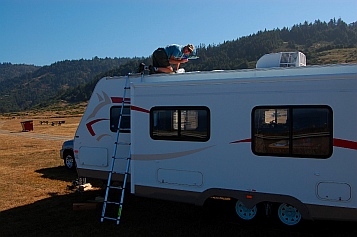
Getting psyched to start drilling holes in the roof. Mark
was naturally quite worried about this part of the
installation.

Westport-Union State Park Campground in California
about 150 miles north of San Francisco was a nice
place to do this installation.

Finished product, situated between a roof hatch and the
folded down TV antenna.
2007 Fleetwood Prowler Lynx 270FQS
We purchased our Fleetwood Lynx travel trailer as a fulltime RV,
and we lived in it from May, 2007 to May, 2008. We bought it with
the idea of "Go cheap, go small, go now." We wanted to use our
existing truck ('04 Toyota Tundra), and this trailer was the largest
size that our truck could handle (theoretically). We wanted a travel
trailer so we could have a cap on the truck and keep our bikes out
of the elements. What appealed to us about the Lynx was its very
spacious interior for its length. It had an open and airy feeling
inside, and had a lot of storage space. It was the ideal introduction
to larger sized RVs.
The 2007 Fleetwood Prowler Lynx 270FQS is a 29'
travel trailer from end to end, including the hitch, and
is 27' x 8' inside with a 3' x 14' slideout, providing 240
square feet of living space. It weighs 5,500 lbs dry
and has a GVWR of 7,300 lbs. It was billed as "half-
ton towable" but we had trouble towing it through the
mountains with our 2004 4.7 liter Toyota Tundra. We
towed it for about 4,000 miles with that truck and
then replaced the truck with a Dodge Ram 3500
diesel. The trailer holds 40 gallons of fresh water, 40
gallons of grey and 40 gallons of black. It has a
15,000 BTU air conditioner and 35,000 BTU furnace.
There is a single slide that is 3' x 14' which contains the dinette and
sofa. The queen bed on this model was a short queen (74.5" x 60"),
but Mark modified it to be a full quuen (80"x60"). The bed lifts up to
a huge storage area underneath that can be accessed by hatch
doors on both sides of the trailer. It has a 6 cubic foot refrigerator,
kitchen sink, range, microwave and pantry. The bathroom has a
shower, toilet and sink.
We used an Equalizer hitch with a 12,000 lb rating. The hitch broke
twice. Fortunately we were not hurt either time. The first time the
welds cracked all around the hitch head. The second time one of the
two bolts holding the hitch together sheered off when we came down
a driveway leaving a bank parking lot. Equalizer was very good and
replaced the hitch head when the welds broke. We replaced the hitch
bolts with #8 rather than #5 bolts (only a few bucks) just a few miles
from where we noticed the one had sheered off. We got 9-10 mpg
while towing with the Tundra and 11-12 mpg while towing with the Dodge.
This trailer was an ideal starter for fulltime RVing. In it we learned about
solar power, inverters and boondocking, and it taught us about the things
that were vital and the things that were unimportant in a fulltime rig. In the
end we realized the Tundra was not strong enough to tow the Lynx and we
upgraded to a long bed, single rear wheel Dodge Ram 3500 one ton. It was
more truck than the Lynx needed, but we purchased it knowing that one day
we might get a fifth wheel.
By starting with the little Lynx we got on the road sooner rather than later,
and we had time to research alternative big rigs at leisure. As we traveled
we quizzed everyone we met in a larger trailer to find out what they liked
and didn't like about it.
We visited dealerships in towns from Oregon to Florida and slowly educated
ourselves about the brands, makes and models of the larger rigs.
There is no way that we could have done that kind of research when
we were working. We finally decided the Lynx was too small during
the long cold winter nights, and being a lightly built "half-ton towable"
trailer, it was a little fragile for the long term. We also discovered that
it was very awkward to get into the storage space in the back of the
truck and we decided the bikes didn't really have to be stored out of
the elements.
Our solar setup on this rig was one Kyocera 130 watt solar panel
mounted permanently to the roof (not able to be tilted towards the
sun), and a Morningstar Sunsaver charge controller connected initially
to two 12 volt Nautilus Group 24 batteries. We upgraded the batteries
to two 6 volt Energizer batteries from Sam's Club after six months.
The first pair of batteries had 140 amp-hours of capacity and the
second pair had 220 amp-hours of capacity. The solar charging
setup provided about 25-50 amp-hours of battery charging capacity
per day, which meant that we could use about that much battery
power in the trailer each day without running the batteries down.
We had an 800 watt inverter connected directly to the batteries and we
ran a power strip style extension cord from its AC receptacle through
the storage area under the bed and into the trailer. We had to go
outside to open the storage hatch to turn on this inverter, so we used it
only when we wanted to run the vacuum cleaner (which draws 300-400
watts).
Inside the trailer there was a cigarette-lighter style DC connector for
the antenna boost system on the wall next to the TV shelf. We kept a
tiny Radio Shack 150 watt inverter on the shelf and turned it on
whenever we wanted to charge the computer, the razor, the camera
batteries or the toothbrush, or whenever we wanted to watch TV or
DVDs. This little inverter's fan quit once, but Mark lubed it up with
WD-40 and it ran daily for 3-6 hours each day for the year that we
lived in this trailer. It is amazing that a tiny $60 gadget could give us the ability to run all the AC appliances that we wanted to run
(except the vacuum). We had never used a microwave much in our house, so we didn't bother getting an inverter large enough
to support the microwave (950 watts). So we used the microwave as a breadbox.
We drycamped 83% of the time that first year -- 305 nights. The solar
setup was more than adequate for the entire year except for the cold
winter months, December - February. Until that time we never paid
much attention to our electrical use. The four LEDs that showed the
status of the batteries generally had all four LEDs lit whenever we
checket it. During the winter months the days were short, so the
panel did not have much time to get its charging done; the sun rode
low in the sky, so the panel did not sit at a great angle to the sun; and
the nights were long, so we sat around for hours while it was dark
outside, running the lights and the battery-draining furnace. To
compensate, we used oil lamps for light at night and we wore a lot of
layers. This is okay for a "roughing it" vacation, but it wore on our
spirits after a while. It was clear by the end of the winter that we
needed more solar and battery capacity, a non-battery-draining
heating system, and more seating options in the trailer!
In the end it was hard to let the little Lynx go. John and Carl at the dealership where we traded it in were very patient as we
continually sang its praises and wondered aloud whether the new huge fifth wheel would measure up. The Lynx had everything
we needed, and if we had been traveling just 6-9 months a year we never would have given it up. However, when your only
home is your trailer, little things like comfortable furniture, space to lie down on the floor and stretch, and general ruggedness
become important. I'm not 100% sure, but I think the fellow that bought the Lynx from the dealership was a man who had just lost
his home -- a 1980's vintage Holiday Rambler travel trailer -- to a tornado that had flattened his town of Pricher Oklahoma. If that
is the case, then I know the Lynx is very much appreciated by its new owner.