

Big Boys are everywhere...

...Coney Island Hot Dogs are too

Despite the depressing news on TV, Spring had sprung on Belle Isle in downtown Detroit

Harsen's Island Ferry holds 9 or so cars
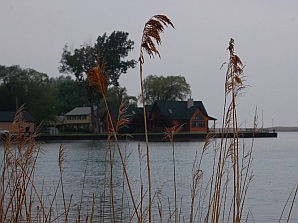


B&B in San Souci

Riverside Grocery

Storefront in San Souci


Smoke stacks on the Canadian side of the St. Clair River

Pretty homes along the river too...

Pt. Huron, Michigan (US) - Sarnia, Ontario (Canada)
Bridge

Mark buys us a basket of Bridge Fries - tasty!

Classic red barns dot the landscape

Roadside farm stand on Lake Erie

Score! Baked goods galore and veggie garden
treasures too.

Trapping invasive Gobi fish for experimentation at the
University.
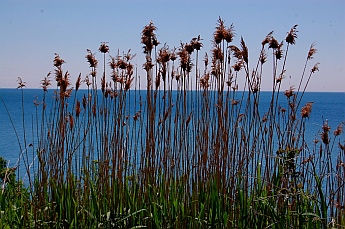
Lake Erie

Lake Erie harborfront

Returning to Detroit via Windsor
Lake St. Clair, Michigan
Late May, 2009 - We arrived from the Burbank, California airport to a wonderful, warm family
reception in Detroit, Michigan. Mark hadn't lived there in 30 years, and since then had made
only short visits, so we had many great get-togethers ahead of us. In between, we wanted to
squeeze in some sight-seeing, as I had never seen much of Michigan, and Mark's motorcycle
trips around the state were back in the days when he had long hair, short shorts, and Rock
hadn't yet been labeled "Classic."
We arrived in Detroit at an especially dark hour in the city's
history. Chrysler was in bankruptcy, GM was headed that
way soon, and most people we visited were out of work.
Unfortunately, I forgot my camera as we toured some of the
amazing mansions that were built by the auto industry's
icons in the days when their profits flowed like wine. The
sultans of that industry lived better than kings. The opulence was breathtaking. I could only
wonder what the factory workers thought in the early 1900's as they saw these castle-like
estates going up. No wonder the unions became so strong: the profits were staggering and
the leaders weren't into sharing.
The auto industry was a cash cow that kept giving and giving and giving, for decades. Eventually everyone had a piece of the pie,
and as the news anchors droned on about the industry's current woes, like the retirees losing their vision and dental benefits
(gasp!), we heard a few back stories about Generous Motors that flushed out the details. From more than one person we learned
how folks on the line used to punch in at work, head to the bar for the day, and then punch out. Or punch in, find a quiet spot to
sleep through their shift, and then punch out. The party lasted for almost a century. I couldn't help but wonder: how would the
founders of those companies feel if they saw their city today? Where would their industry be now if those early leaders had instilled
a culture of productivity, cooperation and true generosity instead of one based on greed?
The story of Detroit's malaise filled the airwaves each night. A mansion
that had sold in recent years for $15 million got auctioned off during our
visit for less than $5 million. Half of the gorgeous estates we drove past
along the Grosse Pointe waterfront were for sale. The once
unstoppable flow of profits had dried up.
Eager for some
pretty scenery, we
drove a circle loop
around Lake St.
Clair, the Detroit area
lake that sits between
Lake Huron to the
north and Lake Erie
to the south, dividing
its shores between
the US and Canada.
Harsen's Island was
our first stop, and we drove onto the ferry for the 10 minute ride to the
island. Harsen's island is very rural at one end, with graceful homes
spread out along the lake.
At the other end, the village of San
Souci beckons visitors with charming
victorian B&B's, cute shops and a laid
back air.
We stopped at the Riverside Grocery
for lunch, watching some kids rolling by
on their bikes and a pair of young
lovers sitting side
by side gazing at
the boats in the
water. This
seemed a perfect
place for languid
summer afternoons.
A little further up the coast we
walked around Marine City and
watched another ferry boat carrying
people across the river to and from
Canada. We heard later that this is
the best place to cross the border,
as the lines are short. Along the
river, both the Canadian side and US side have stretches
of gracious homes mixed with stretches of heavy
industry.
After spending some time on both sides of this river, it
seemed that there is a strong unity that bonds the people of this region, regardless of the
presence of an international border between them. We saw homes flying both countries' flags
off their porches, and we saw posters with both flags crossed and the words: "United we
stand." So it was odd, and sad, to see several US border patrol cars sitting on the US side
facing Canada. We are accustomed to seeing them in southern California and Arizona, but
here they seemed out of
place.
Up in Port Huron we took
the bridge across to
Canada's small city of
Sarnia, Ontario. The
lady at the visitors center
suggested we get some
Bridge Fries from one of
the vendors under the
bridge. Served Canadian
style with vinegar, we found
her recommendation was
right on. Yum!
Heading down the Canadian side of the St.
Clair River we felt ourselves relaxing. The
homes are nicely spread out. We stopped
at Bogey's Inn near the village of Sombra
for the night and ended up in their largest
suite for their regular motel room rate. "Last
year at this time I was booked solid," the
proprietor said with frustration. The night
we stayed we were the only tourists there.
We veered away from Lake St. Clair the next morning to catch a glimpse of Lake Erie. The fertile
farmlands stretched for miles with classic red barns and homesteads dotting the green vistas.
Suddenly the beautiful shores of Lake Erie opened up before us. The lake was turquoise and clear,
and the homes were perched high above the lake with rolling grass lawns stretching down to the water.
We stopped at a farm stand, thinking we'd grab some apples to snack on. As
we approached, the luscious aroma of baked goodies wafted through the
door. We stepped inside and were suddenly surrounded by pies, buns,
breads, cookies and the like -- along with fresh picked healthy veggies. At
the sight of those pies Mark was in heaven. "Wow! I'm going to get one of
everything," he joked with the lady at the counter as his eyes darted from
table to table. I wandered around looking for the one perfect snack, admiring
the rows of maple syrups and jams while I mulled over getting a muffin or a
scone or a mini sweet loaf. When I walked over to the register with my lone
apple bran muffin, there was Mark with "one of everything" -- and two of
several things -- laid out across the counter in front of him. He grinned at me
sheepishly and shrugged. How often do you find a gold mine like this?
We piled our boatload of baked goods into the car and had a small
feast of pies and cookies while overlooking the lake's crystal waters
across the street. There was an opening that led to the water, and we
wandered down to dip our toes in the lake. Some University students
were trapping Gobi fish, an invasive non-native fish that they want to
remove from the lake. They were
taking the Gobies back to the lab to
try to find some natural deterrent to
limit the spread of this unwanted
fish. Unfortunately, though, the
Gobi's were proving especially
tricky to trap.
We stopped in a small harbor town
to stretch our legs, and continued
our slow journey back towards Windsor, Ontario and the
Detroit River. Faced with another border crossing back to
Detroit, and not sure exactly what the rules were regarding
baked goods crossing the border, we stopped and gobbled
down as many of our remaining pies and pastries as we
could. The strawberry-rhubarb pie was out of this world, and
we each slyly unbuttoned the top button on our pants to
make room for more. But even stuffed to the gills, we still
had some pastries and pies to go. We just had to risk losing
our booty the border. Of course, in the end, although every
car in line at the border had its spare tire removed and
inspected, causing an hours-long traffic jam at the tunnel, no
one asked if we were bringing in any contraband pies.
After a few more days of family gatherings, we headed out
on a slightly longer sojourn into Ohio and Indiana.