
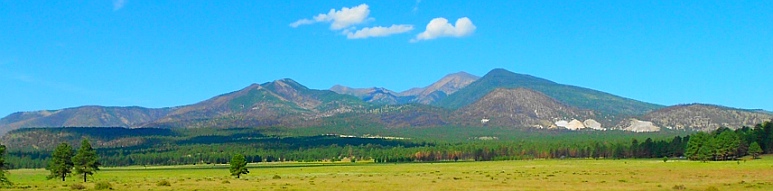
Flagstaff's San Francisco peaks seen across the meadow outside Bonito Campground.
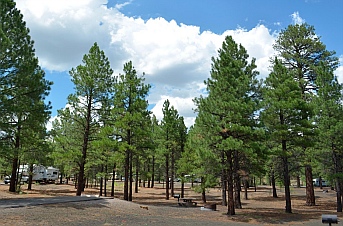
Coconino Forest's ponderosa pine woods.
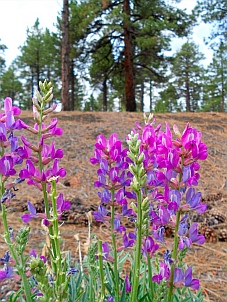
Wildflowers at Bonito.
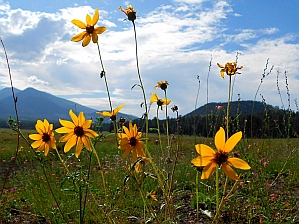
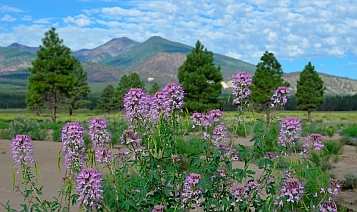
San Francisco peaks.
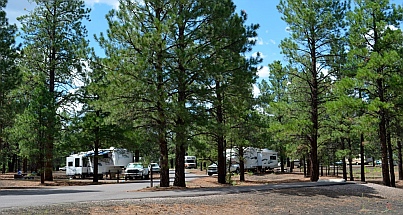
Bonito Campground.
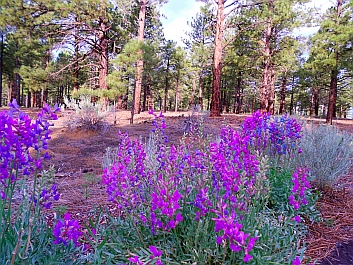
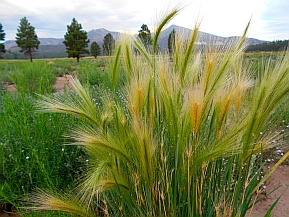
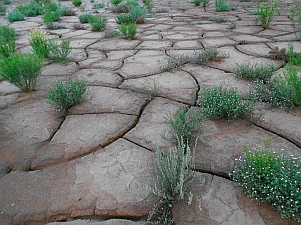
The meadow that used to be filled with
sunflowers is now parched and cracked.
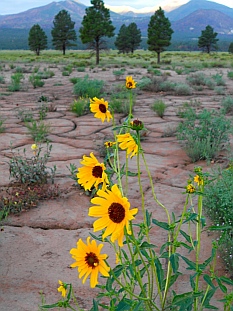
Some sunflowers line the road.
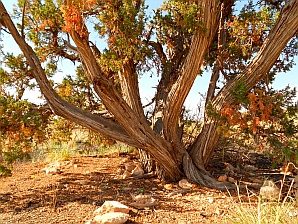
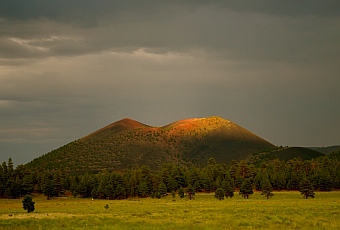
Sunset Crater just before a downpour.
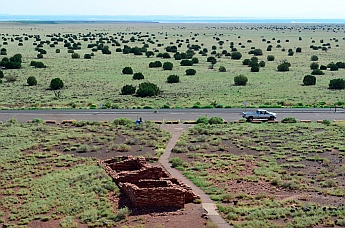
Looking down at Nalakihu from Citadel Pueblo.
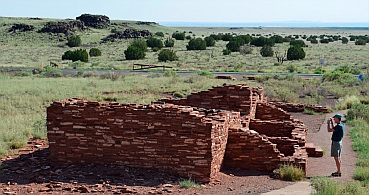
Nalakihu Pueblo.
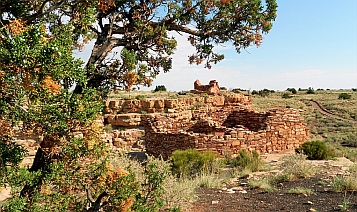
Lomaki Box Canyon dwellings.
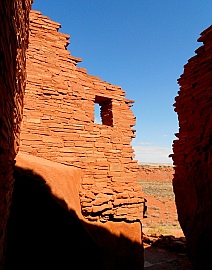
View from inside Wupatki Pueblo.
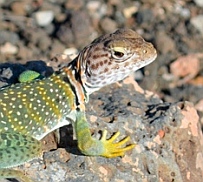
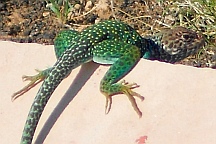
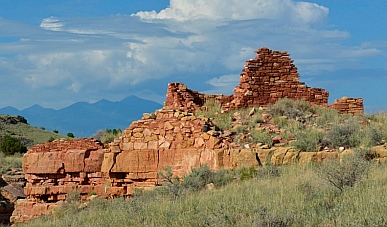
Lomaki Box Canyon dwellings.
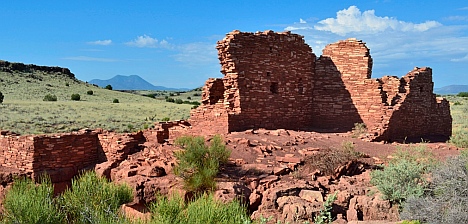
Lomaki Pueblo.
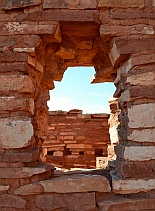
Lomaki Pueblo.
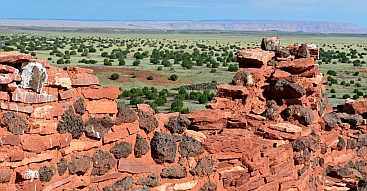
Looking out at the high desert plains from Citadel Pueblo.
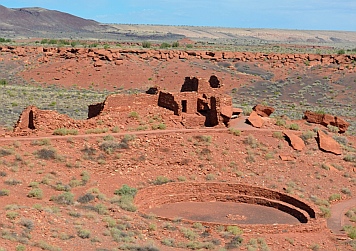
Wupatki Pueblo and its round Kiva (gathering place).
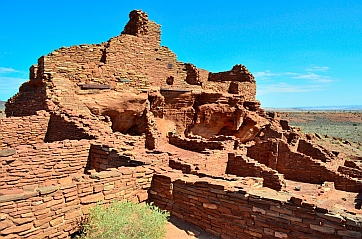
Wupatki Pueblo, home for about 100 people.
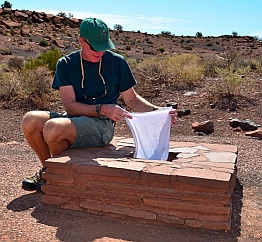
Mark plays with the blow hole's breezes.
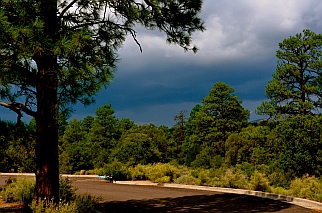
Our picnic is cut short by looming black skies.
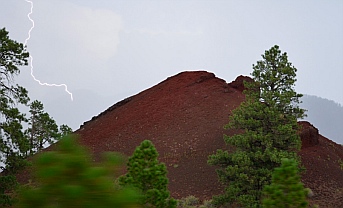
Lightning!
Bonito Campground & Wupatki Nat'l Monument, Flagstaff, AZ
August, 2011 - We crossed the Sea of Cortez from just north of Bahía Concepción on the Baja side of Mexico to San Carlos on
the mainland side in late June, a 75 mile jaunt. It was the very best sailing day in our entire seven months spent cruising the
Mexican coast: bright sunny skies, flat seas, and a sprightly wind drawing us along on a close reach. Our arrival in San Carlos was
the first step of our re-entry into civilization and the US, and each stage of re-entry was a shock.
Perhaps the most jarring
moment in this process was our
first trip to a Super Frys
supermarket in Phoenix. What a
staggering abundance of
gorgeous produce, so beautifully
presented and in such perfect
condition! Mark and I stood and
stared in amazement, mouths
open in awe. "Where's my
camera?" I cried. Our friends
thought we were nuts.
Getting to Phoenix from San
Carlos required an 11 hour bus ride,
and we then returned to San Carlos by
truck (a mere eight hour drive) to deliver
some things to the boat and relieve the
boat of other things
we didn't need any
more (winter
clothing!).
Then over the next
six weeks we
skidded from being
merely bone tired to
being utterly
exhausted as we ticked off the endless items on our "to do" list of
chores. We lived as perennial house guests, bouncing between
generous friends' homes.
The madness culminated with finding new tenants for our
townhouse. Sleeping on an air mattress in our empty
townhouse during a frantic week of repainting the interior, we
realized we had come full circle. Four years of traveling, with
only the briefest visits to Phoenix, and here we were back in
our townhouse again, surrounded by the same smells, the
same noises, the same sensations that had been the essence
of our old home. What had the last four years meant? Had we
grown or just taken a big detour through life? There was no
time to think about that; there were chores to do!
Once our
responsibilities were
behind us, we grabbed
the trailer out of
storage and dashed up
to Flagstaff as fast as
we could go. We made
a beeline for Bonito
Campground, our all-
time favorite
campground. Despite
being die-hard
boondockers, we splurged on a weeklong stay there while we re-familiarized
ourselves with the RV lifestyle and restocked the trailer with everything we had
pillaged from it for the boat.
Here at 7000' elevation we finally began to take stock and get some perspective on all
that we'd been through. When we left Phoenix in 2007, real estate was peaking at
astronomical prices. Now, on our return, there was a sea of homes in various stages
of financial distress and foreclosure. Few real estate signs were visible, however. The
panic was largely on paper and online, and too often was manifested in midnight
moves. Some of our once-wealthy friends were now scrambling to pick up the pieces
of their lives, while other less well-heeled friends were suddenly able to afford
gorgeous homes.
The city's everpresent, massive
expansion into the outlying pristine
desert was temporarily on hold while it adjusted to the new economy. Our
memories of Phoenix as it once was were overlaid onto Phoenix as it is today,
and there were areas where the images meshed, and areas where they were
like two different places.
Some of the changes were within ourselves as well. Our souls were the same,
but all this traveling had expanded our knowledge of the lands around us, and
we had come to know ourselves better too. These thoughts swirled around us
as we rested and strolled about Bonito's pretty grounds. Life aboard Groovy in
Mexico felt like a far distant dream.
The land surrounding Bonito Campground has changed too. Last year this part
of Coconino National Forest was devastated by the Schultz wildfire which wiped out some
15,000 acres, mostly on the area's mountain slopes. Campers at Bonito were evacuated
twice, first to escape the fire and later to avoid the erosion-caused floods. As a ranger
explained to us, the floods altered the landscape forever and
even moved floodplains. Many nearby homes were damaged
or lost, a young girl drowned, and the water rose to about 8' in
the campground's amphitheater, leaving the place buried in
sludge.
Knowing some of this before we arrived, it was with trepidation
that we approached the campground. The meadow that is
usually teeming with bright yellow sunflowers at this time of
year was devoid of blooms and parched and cracked in
places. But what a thrill it was to see and smell our beloved
ponderosa pine woods. Bonito's soul is the same, just singed
a bit here and there. The wildflowers still line the edges of the
roads and promise to return to the meadows. The
hummingbirds still buzz the campers looking for easy
meals in feeders. Some ponderosas have blackened
trunks, but the tops are green.
However, the Schultz fire was
nothing compared to the volcano
that erupted at next-door Sunset
Crater around 1050 AD. Spewing
marble-to-football sized chunks of
rock into the air for a few months
(or possibly several years), the
evacuation of the local farmers
lasted for generations. The
volcano layered the land for many
miles around in a thick blanket of
cinder. In its last moments it spat
out a final burst of cinder that was oxidized to a rust color. This gives the mountain a distinctive
orange-red top to this day, and the sun and shadows spend their days playing with the color.
We took a drive through the
nearby Indian ruins at Wupatki
National Monument. These
were built 50-100 years after
the eruption by the so-called
Sinagua people who returned
to the area to find that the
blanket of volcanic ash now
helped keep rare moisture in
the soil. They somehow eked out a farm life, living essentially
"sin agua" or "without water."
The ruins are like tiny dots on vast open plains, each located
several miles apart. The San Francisco mountains line the
horizon, but there are few trees or other protection between the open lands and the sky.
We opted to start at the far end of the drive, visiting the more remote
ruins first. These were built above small box canyons that are
essentially ditches in the ground bounded on two or three sides by 100'
rock cliffs. The cliffs provide the only weather protection in the area.
The Sinagua people understood real estate: location location location.
It was early
morning and utterly
silent. The
crunching of my
feet on the gravel paths made the cottontail
bunnies run, and lizards of all shapes and
sizes scurried for cover under rocks along
the trail. We were the only visitors at each
ruin, lending a sense of magic to each
place.
At the biggest ruin, Wupatki Pueblo,
Mark played with the natural
"blow hole" air vent. The
National Park Service has built
a structure around it, but the
blow-hole itself is the real deal,
blowing air out or sucking it in
depending on ambient
temperatures and air pressures.
As we returned to the
campground the sky turned
black, thunder rolled and
lightning streaked the sky. For
seven months on the boat in
Mexico we hadn't seen a single
drop of rain. The deluge that came now was fantastic.
We drove through it
laughing, barely able to
see the road ahead, and
we jumped back in the
trailer, glad to have real
shelter. It was so great to
be back in our RV lifestyle
again. The rain pummeled
our roof all afternoon, and
we fell asleep to the plink
plink plink of raindrops
overhead. Little did we
know the downpours
would continue for several days. The sun finally returned in full blaze
as we took off to head north to Dixie National Forest in Utah.
Other great RV camping areas:
- Lost Dutchman State Park: GORGEOUS scenery & RV campground!
- Windy Hill Campground + Tonto National Monument
- Lynx Lake, Arizona – Great RV Camping Near Prescott!
- Dead Horse Ranch State Park + Tuzigoot and Clarkdale
- Catalina State Park & Roosevelt Lake: RV Camping in AZ
- Oliver Lee Memorial State Park, New Mexico – A Dog’s Eye View!
- Lost Dutchman State Park Campground – Arizona Gold in the Superstitions
- Lake Pleasant & Canyon Lake – Waterfront Camping in Arizona’s Sonoran Desert
- Sand Hollow State Park, Utah – An Oasis in the Desert!
- RV Camping with the Rock Art Petroglyphs in Gila Bend, AZ
- City of Rocks State Park, NM – RV Camping in the Hoodoos!
- Boondocking at Big Bend National Park – Cheap & Scenic RV Camping
- Roosevelt Lake – Lakeside Camping in AZ
- Valley of Fire, NV – A Cauldron Cooled
- Zion NP, Kodachrome Basin & Snow Canyon, UT – Great Red Rocks!
- Goblin Valley, UT – Where the Ghosts Are
Our most recent posts:
- Buckskin Mountain State Park – Fun on the Colorado River! 01/31/26
- How to Install Starlink Gen 3 in an RV? Use the Speedmount! 08/07/25
- Escape to Paradise – Rocky Mountain Magic! 08/01/25
- Is Forest River a Good RV? Well Built? Here’s Our Experience 06/20/25
- Sunset Crater Nat’l Monument – Lava & Camels at Bonito CG! 06/06/25
More of our Latest Posts are in the MENU.
New to this site? Visit RVers Start Here to find where we keep all the good stuff!!