
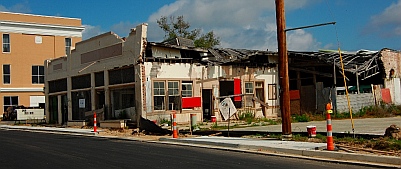

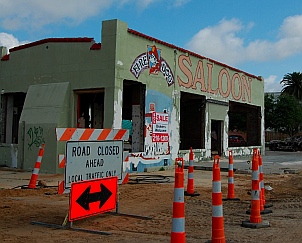
Words of hope on a building in Old
Town Bay St. Louis, MS

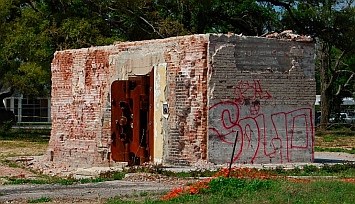
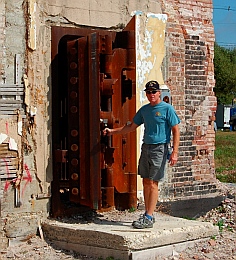
SOLID
One building reborn. Another waits its turn.
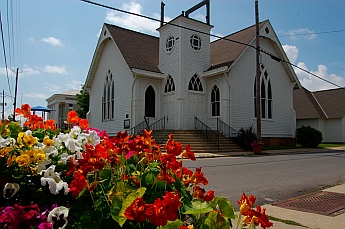
Missing steeple but lots of faith.
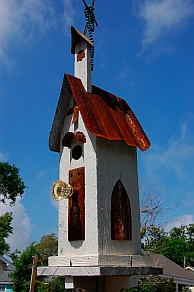
Weathervane

Old Town Bay St. Louis, Mississippi
April 20-24, 2008 - We drove along the Gulf Coast of Florida and, after crossing
Alabama on I-10, we dipped down to the coast again in Mississippi. The further west we
drove the more we encountered the fallout from Katrina. It was startling to see how
extensive the damage was. Not living anywhere near this area, it had been easy to think
that life returned to normal once Katrina was out of the headlines.
Instead, we found a
coastline still reeling
from the devastation
three years earlier.
The coastal road in
Mississippi was in the
process of
being rebuilt.
The once
gorgeous
mansions
that lined the road were stark
reminders of the raw power hidden in
the innocent, sparkling waves that
lapped the shore. Only one in five of
those coastal mansions had been
repaired. The rest stood forlorn and
vacant, windows blown out, roofs
collapsed, walls wrapped in "caution"
tape. The weeds grew thick and tall
around the foundations and the
gracious lawns that swept down to the sea were
overgrown. We drove in awed silence. We had had no idea.
We stopped in a visitors center,
and the host spoke almost
reverently of the Mississippi
governor whose savvy use of
federal funds had apparently
begun to breathe new life into
a region that had been like a
war zone. On his advice we
took a detour and stopped at
the tiny coastal community of
Old Town Bay St. Louis. What
a delightful find.
This town shared the epicenter of Katrina with eastern New
Orleans. A tiny community, it sits right on the water. Some of
its businesses used to line a waterfront road. After Katrina
roared in from the Gulf, all that was left of a one-time bank
building was the bank's vault. The massive door was totally
rusted and was stuck partly open. The concrete wall on the
side of the vault had a single spray painted word: "solid."
Today Old Town Bay St. Louis is rebuilding itself as a kind of artists' colony, with
cute, funky homes and shops. As we drove into town with our huge rig we were
greeted warmly and shown where to park so we could walk the town. What a
contrast from Gulf Breeze, Florida, which we had just left, where the visitors
center had a huge sign out front, "No Motorhomes," and the mammoth
empty parking lot across the street had similar signs posted every few feet.
In Old Town Bay St. Louis, with its tiny streets and tight parking, they were
hungry for visitors, even those pulling large trailers.
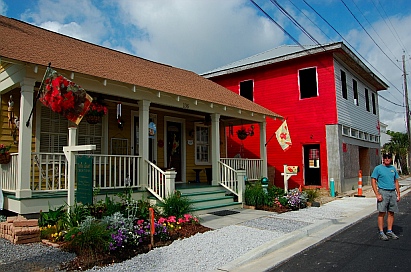
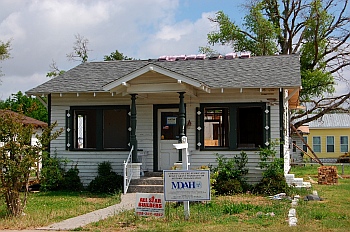
Reconstruction takes a very long
time. Next to a building that had
found new life we would see one
that was still hoping for help.
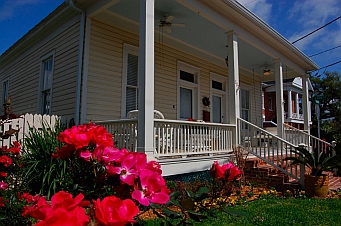
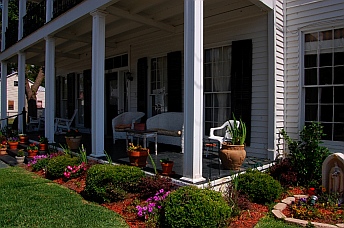
However, the homes that were
completed exuded a relaxed kind of
charm, with pleasant porches and
beautifully tended gardens.
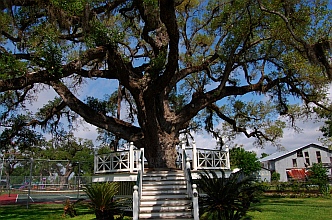
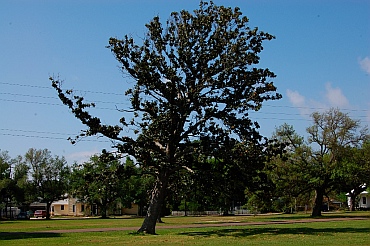
A beloved Live Oak tree was
encircled with a pretty white
deck. Graceful stairs
beckoned visitors to climb up
towards the heart of the tree.
This tree was tougher than
Katrina and still stood straight
(for a live oak) and proud.
Others leaned to one side.
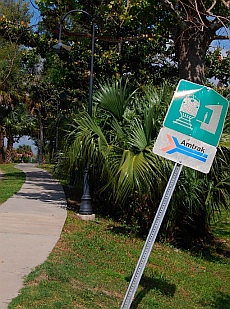
Looking around town there was no
mistaking which direction Katrina took
as she blew through the area. Trees
and signs all leaned in one direction,
and lampshades were dented on one
side. It was startling to imagine the
force of the wind that would leave
sturdy trees forever tipped.
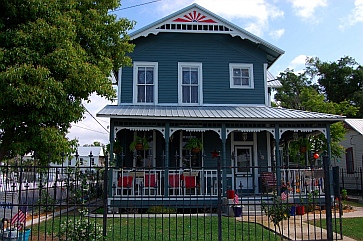
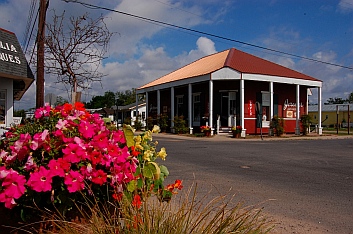
But today the town was filled to
overflowing with colorful flowers.
There was an air of happiness,
purpose, accomplishment and
whimsy everywhere. Pretty
gardens, funny weathervanes, and
unique gingerbread houses made
the tedium of reconstruction seem
almost fun.
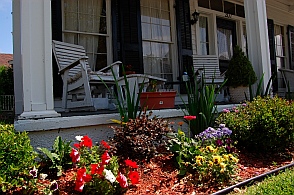
Relaxation seemed important in this
town too. Many homes were fronted
by inviting porches cradling comfy
chairs and bright flowers.
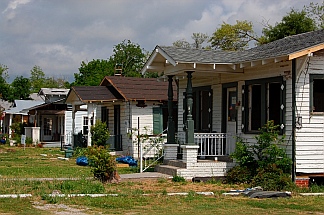
A row of little homes right in the center
of town has yet to be rebuilt. I have no
doubt that these cute buildings will be a
focal point in a warm, chatty community.
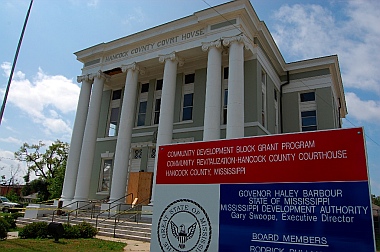
As we walked around we saw that
little houses weren't the only ones
hit hard by Katrina. Even the
county courthouse came away
from Katrina battle scarred and
was now wrapped in a bandage of
scaffolding.
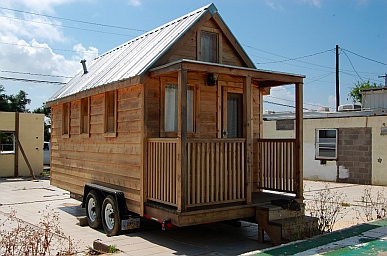
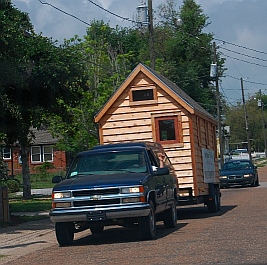
Not everyone displaced by
Katrina ended up in a FEMA
trailer. Some simply took a
trailer frame and erected a tiny
traditional house on it. We saw
one parked and another
heading down the road. They
were cute, but we still loved our
little Lynx. We were interested
to learn later that our Lynx was built to the same
specs with the same materials by the same
people and in the same factory as over 300 of the
FEMA trailers. Our trailer was a delightful home
and I wrote to the Fleetwood factory workers --
who were so saddened to see their hard
work after Katrina maligned in the press --
to let them know they had a happy
customer here. Maybe the difference in
our experience with our trailer is that it was
our ticket to freedom, and we paid for it out
of our own pockets.
From the Gulf Coast of Mississippi we
made our way inland to historic city of